Showing posts with label Cardiocrinum giganteum. Show all posts

Friday, November 23, 2012

A Disquieting Metamorphosis

November is the stormiest and wettest month in Seattle.  This November has been no exception...we've already surpassed our average of 5 1/2 inches of rain for the month and experienced a few good doses of wind - hurricane-force in some areas.  Although it is still mid-fall, November can easily bring lowland snow and prolonged subfreezing temps.  But luckily there's been none of that so far!

As warm, dry, and sunny gives way to cold, wet, and cloudy, there is still much to look forward to in the garden...collecting and germinating seeds, testing winter propagation techniques, winter bloomers, frost-sweetened brassicas, and a chance to stand back and re-imagine different areas of the garden.

The Cardiocrinum giganteum (Giant Himalayan lily) I planted a few years ago went to seed and I am going to try my best to raise a cardiocrinum family.

Cardiocrinum giganteum seed pods
Here is what it looked like when it was in bloom:

Cardiocrinum giganteum flowering
Each seed pod contained hundreds of flat, paper-thin seeds.

Look at all those seeds!
To germinate the seeds, I took a plastic-mesh tray and lined it with some left over row crop cover to keep the bugs away and filled it with some potting mix.  Then I sprinkled some of the fresh seeds right on top.


I read that it takes a while for Cardiocrinum seeds to germinate, so it is a good idea to cover the seeds with gravel in order to prevent a film of green slime from growing over the top. 


 Here is the end result: 


It's going to stay outside all winter and will probably be forgotten until sometime in the springtime...

Saturday, June 9, 2012

Cry Me A Cardiocrinum

I could complain about the fact that we've been 10 degrees below normal in June so far with 2 inches of rainfall, already more than our monthly average, but I'm not going to.  That's not why you're here.  You're here to look at pictures like this:

Cardiocrinum giganteum
This lily is incredible, and thrives in our cool coastal climate.  It is 8 feet tall with a sturdy stalk.  It is fragrant like other Oriental liles, yet is in bloom right now in late spring vs. mid-summer for Oriental lilies.

The picture below shows just how tall it is, with the flowers higher than the top of the arbor.


Aloe 'Johnson's Hybrid'
I was noticing how closely this aloe resembples a kniphofia.  As it turns out, the two genuses are closely related, both being in the Asphodelaceae subfamily.

Kniphofia 'Shining Sceptre'
Speaking of Kniphofias, this is my favorite one called Kniphofia 'Shining Sceptre'.  I'm not sure if there are any truly fluorescent plants, but the two-toned orange and yellow flowers are about as fluorescent-looking as any I've ever seen.


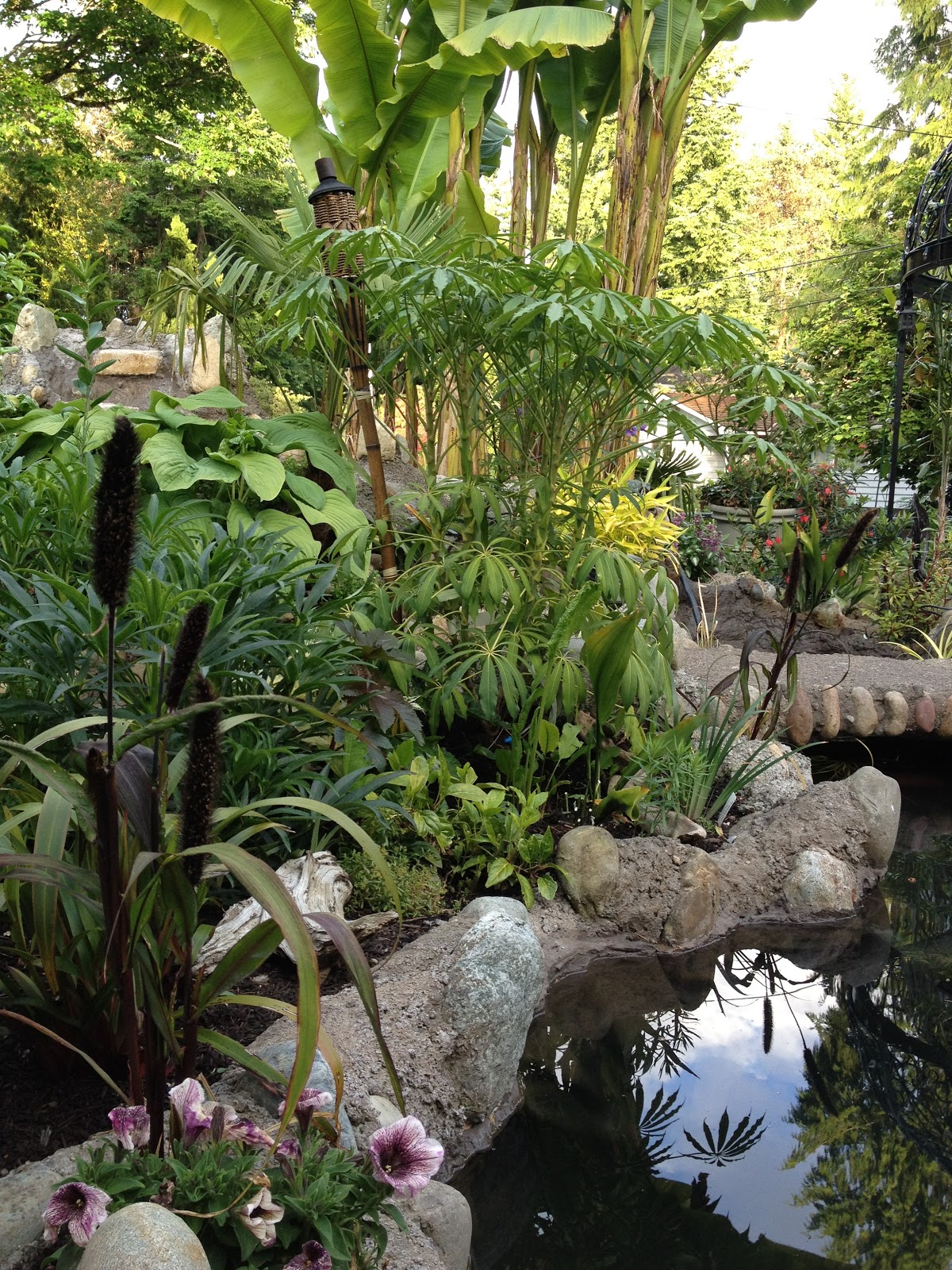
I saw some ornamental millets at Furney's Nursery and bought two, not knowing where I was eventually going to plant them.  I decided to plant them in this island, but needed one more to balance it out, so I went back to Furney's and got one more.


 A couple days later, I found myself going back to Furney's for two more, filling in a couple areas by the pond.

Pennisetum glaucum 'Purple Baron' & Solenostemon 'Trailing Burgundy'
Today marked the LAST time I went back to Furney's to buy an ornamental millet.  This coleus and millet make a nice duo.

Tuesday, April 3, 2012

Rhododendron Time Machine

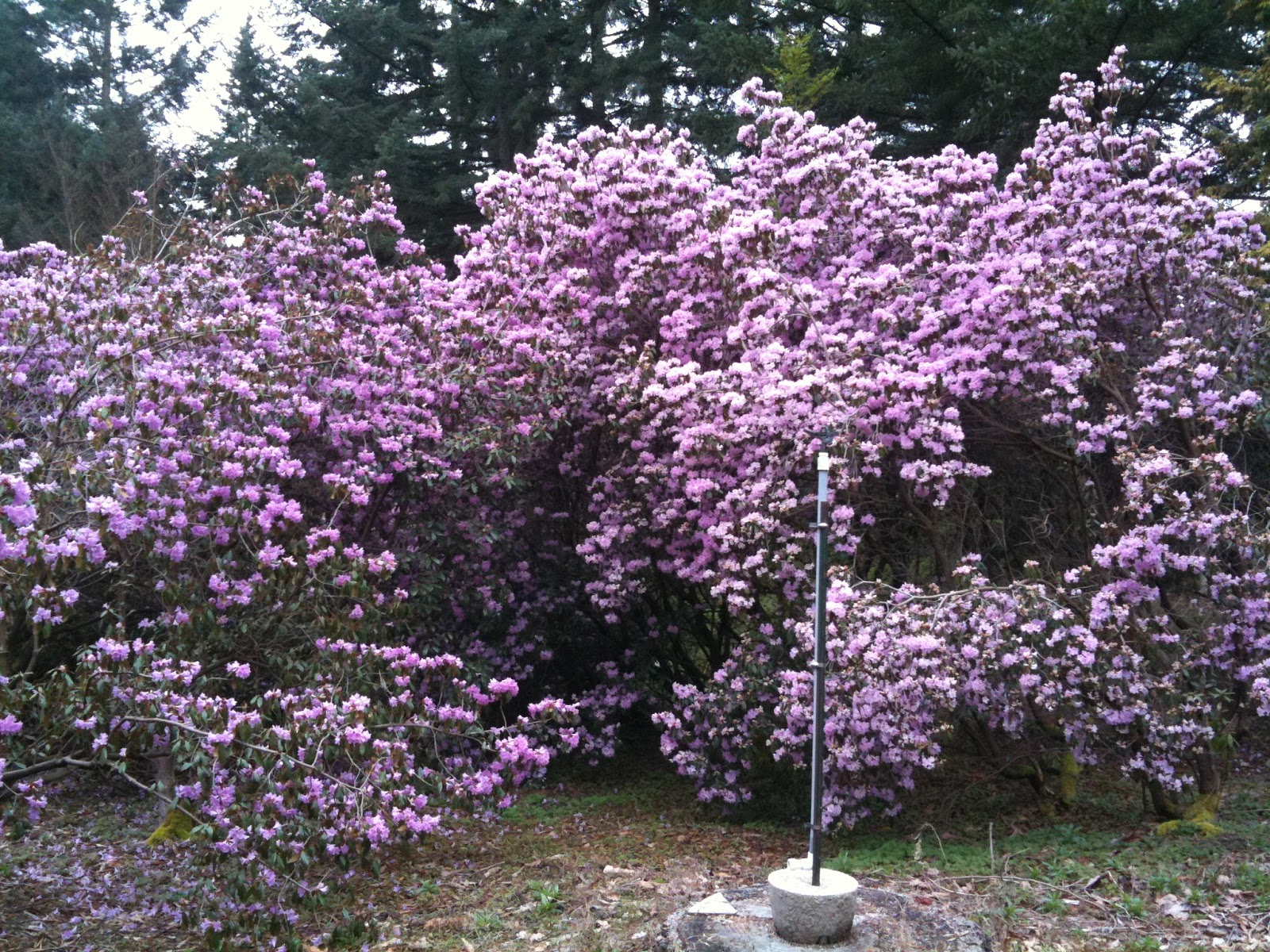
Rhododendron kesangiae
The pictures in this post today are from exactly two years ago - April 3rd, 2010.  They are all from the Rhododendron Species Garden in Federal Way.  There, I discovered a few great plants including this stunner:
Cardiocrinum giganteum (Giant Himalayan Lily)
I probably would have walked right past this plant if it hadn't been for the 10' tall old flower stalks still hanging around from the previous year.  What perennial shoots a flower stalk 10 feet into the air?  When I walked back to the plant store at the entrance, not only did they know exactly what I was talking about, they also had a few for sale.  Of course I bought one.  I should have bought more.

Matteuccia struthiopteris (Ostrich fern)
I had seen Ostrich ferns before, but never naturalized like this.  They all seem to be unfurling their fronds at exactly the same rate.

Rhododendron sinogrande
It was fairly apparent, judging mostly by the leaf damage, that this king of all large-leaved rhododendrons had endured the relatively cold winter of 2009-2010.  I don't know how or even if they protected it, but if it made it through that winter, it certainly has a lot of potential in the Northwest.

Erythronium revolutum
Usually you have to wait until the summer if you want to see lilies (at least growing outside naturally), but these lilies are doing their thing right at the beginning of spring.

Finally, the rhododendrons in this last picture form a conglomerate about the same size as an average 2-story suburban house.

Saturday, March 3, 2012

Plants Waking Up Right Now


I don't know why this Sorbaria sorbifolia 'Sem' has decided it's a good idea to fully leaf out with a good deal of winter still left, but I am grateful that it takes the risk.  The red-tinged, translucent new growth glows in the sunlight, making this time of year its high season in terms of interest.  By summertime it fades into just another old shrub.


Euphorbias are such weird plants.  This Euphorbia characias is starting to shoot its chartreuse suction cup stalks toward the sky.


There is no such thing as having too many hellebores - especially black ones.


The cold-hardy banana (Musa basjoo) has sailed through this cold season without any protection.  The pseudo-stems are currently about 10' tall, so I'm hoping they will reach their full height of about 20' this summer.


Artichokes (Cynara cardunculus var. scolymus) make a great edible landscaping plant for us in the Northwest.  They should be grown in the perennial border as opposed to the vegetable garden.  The flowering stalks completely die down in the fall, but new rosettes of foliage resume growing from the roots and if the winter is mild like it was this year, they can be almost considered evergreen.  Few things grow as rapidly in our miserable March weather as artichokes.


Here is my pea scaffolding.  It's a bit wobbly, but anything made of bamboo and zip ties has to be indestructible, right?  There are some radishes to the right of the stepping stones that have already sprouted.


Finally, a shot of the rapidly emerging leaves of Cardiocrinum giganteum (Giant Himalayan lily).  This will be its third year, meaning 3-5 more years before blooming.

Monday, April 11, 2011

Sitting here in limbo...

The flowering plums are done, the cherry blossoms are at their peak, and the cool-season veggies in the garden are going strong, but it still feels like winter out there. Here are a few photos from this season's very slow start:

The culms of Musa basjoo (Japanese fiber banana) are now growing about a half an inch a day. Before long they will be strutting their 8' long leaves which always bring a taste of the tropics to the backyard.


In the lower left, Aspidistra elatior (Cast iron plant), cannot get any more tropical looking and happens to be evergreen and hardy here in the Seattle area. I've experimented with growing some of it's variegated cultivars (such as 'milky way') outside without success. But I'll certainly settle for the solid green variety. The plant right next to it is the enigmatic Schefflera taiwaniana (so enigmatic I don't think it has a common name). I purchased two of these last year, they both sailed through the winter with no problems, and are now starting to send out its first shoots of the spring. The plant growing on the porch is Strelitzia nicolai (Giant bird of paradise) which grows happily as a contained plant and doesn't mind the cold as long as it stays above freezing. I kept it in the greenhouse for most of the winter and brought it out a couple weeks ago.


While the subfreezing spells this past November & February didn't kill this opuntia outright, it is now a bit more flopped-over than it used to be. And I should note that trying to take cuttings from this cactus and rooting them outside in November is simply a waste of time. The pinnate-leaved palm is none other than Phoenix canariensis (Canary Island Date Palm), one of the most spectacular palms in the world when it is large. I would like to say it's been growing there all winter, but the one in the photo is actually a recent replacement of one that died (which was itself a replacement).

Unfortunately, the slugs noticed my Cardiocrinum giganteum (Giant Himalayan Lily) before I did.
I've been growing Gunnera manicata (Dinosaur plant) for several years now, and pretty much have nailed down what its needs are in order to achieve mammoth proportions: First, bury the central bud in several inches of mulch for the winter. Make sure this mulch does not get blown off. If the central bud freezes, the plant will send up several smaller shoots. The mulch can be removed once the threat of a hard freeze is gone (late February). Second, it likes to grow in boggy conditions, so keep it well-watered. It doesn't seem to care about being in sun or part shade as long as it's able to soak up as much water as it wants. Third, fertilize the heck out of it (the more nitrogen, the better). It should also go without saying that if it's going to reach 8-10 feet tall, it needs to be growing in great soil, without a lot of competition from trees.