I've visited Seattle's Elisabeth C. Miller in October, June, and now May. I have to say, in terms of the garden looking its best, May wins. Spring ephemerals and many rhododendrons are in bloom, freshly unfurled fronds festoon a flood of fine ferns, and having a nice and sunny mid-spring day, the thrust of the growing season kicking into high gear was spine-tingling.
I should mention before getting started I did already post a
3-part series on the Miller Garden last year, but considering the garden's many rare & exotic specimens, there is always plenty of new ground to cover...
 |
| An overall view of the garden. |
Our group of about 10 was guided by the curator of the Miller Garden, Richie Steffen. I think he literally knows every plant in the garden.
 |
| Heading into the dense, wooded area of the garden. |
 |
| Woodwardia fimbriata (Giant chain fern) |
I was amazed to discover we have a native fern that is evergreen and has gigantic 6'+ long fronds. It is called
Woodwardia fimbriata or Giant chain fern. Its range is from northern California to southern British Columbia, making it hardy to at least 0 degrees F/-18C.
When woodpeckers started drilling into an old cedar tree next to Mrs. Miller's house, the garden's oversight board figured the tree was rotting from the inside out and decided to take it down. They had the trunk cut up in pieces and placed them around the garden. Just like in an old growth forest, the old rotting wood is making a new home for new generations of plants.
Paris polyphylla, a lily relative, is strikingly thin and elegant. It's cousin, Paris japonica, has the largest genome of any living organism (Its DNA sequence 50 longer than a human). Just thought I'd throw that in.
 |
| Plants of different shapes, textures, and shades of green create living tapestries. |
 |
| Blechnum novae-zelandiae |
This is an evergreen fern called
Blechnum novae-zelandiae. As its name implies, it's a New Zealand native. It makes a nice tall groundcover.
 |
| Rhododendron 'Walter Maynard' |
Borderline-hardy rhododendrons seem to work well in pots, where they can be carted under cover should a wintery arctic blast strike. This cultivar is called
Rhododendron 'Walter Maynard'. Its giant white blossoms are very fragrant. I believe the garden has about 20 of these placed throughout the premises, each growing in a pot so it can be carted to safety should winter ever turn ugly.
I was straggling way behind when I took the above photo, otherwise I would have asked what the names of two plants were. Some kind of epimedium and eucomis? That's about as good as you're going to get from me....
 |
| Hydrangea aspera 'Plum Passion' |
Judging from the name, this hydrangea is a hybrid, but it was apparently collected by Dan Hinkley, who is a plant explorer and not really a hybridizer.
 |
| Bonsai wisteria? |
 |
| Rhododendron makinoi? |
 |
Podophyllum 'Spotty Dotty', among others
|
Of course the Miller garden is the type of place that would have mounds and mounds of
Podophyllum delavayi. I've had many opportunities to buy this plant, but paying $50 for a root cutting is just not going to happen.
 |
| Podophyllum 'Kaleidoscope' |
 |
| Arisaema griffithii |
 |
| Wollemia nobilis |
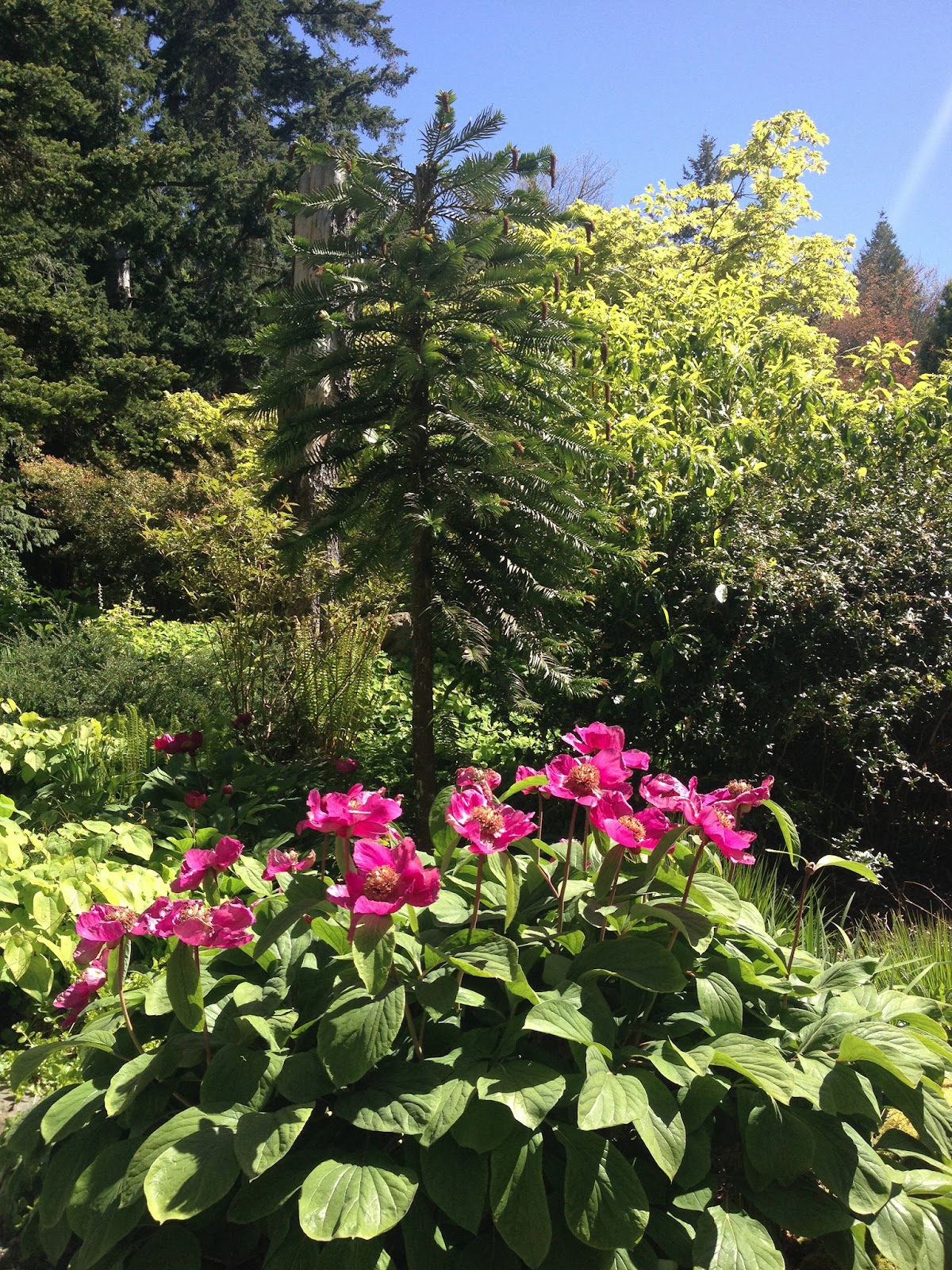
Behind these peonies (at least I think they're peonies) is one of their larger Wollemi pines. According to Steffen, the Miller Garden has the largest collection of Wollemi pines this far north.
 |
| Dicksonia antarctica (Tasmanian tree fern) in the background. I'm not sure what the plant with white flowers is. Could be a hardy orchid perhaps. |
 |
| They had a schefflera, not sure of the species |
 |
| Podophyllum pleianthum |
 |
| Rheum palmatum var. tanguticum |
 |
| Their greenhouse is way too empty... |
 |
Cyperus sp. (Possibly Cyperus glaber)
|
And now for the best part. I saw how this papyrus was growing and suspected that it had overwintered in the ground. When I asked Richie about it, he said it was a hardy papyrus and had been growing there for several years. Right at that point, I heard the sound of trumpets echoing in the heavens as I entered into a new stage of enlightenment. Hardy papyrus? How did I not know about this before?!?!? They are in the genus Cyperus but the species name is unknown. To my utter amazement and forever indebtedness, when we finished our tour, I was handed a 1 gallon specimen to take home. Richie told me how to propagate it from leaf nodules...so at some point I just might have some to share!
Now some bad news: The Miller Garden is already sold out for 2013 but check their website in September or sign up for a Northwest Horticultural Society class at the Miller Garden to try for a spot in 2014. With a bit of initiative, it's pretty easy to be one of the 500 guests allowed into the garden each year.