Showing posts with label Solanum tuberosum 'adirondack blue'. Show all posts

Saturday, March 31, 2012

Another Greenhouse Day

Left to right: Basil, Cilantro, Giant Pumpkins, a Carving Pumpkin seedling, and a Castor Bean seedling (Ricinus communis)

When I bought a package of peat pots to start off my giant pumpkin seeds, I realized they weren't all that expensive (10 cents/pot) so I went back and bought a few more packages.  Now I'm growing everything in them.  The idea with peat pots is, when it is time to transfer them out to the garden, the plants hardly know they are being transplanted because they are planted with the pot directly into the soil.  The plant's roots easily grow right through.  Eventually the pot disintegrates, but I've heard peat pots can wick enough moisture out of the soil to kill the seedling so it is important to completely bury the pot.

Some more peat pot shots:

Freshly planted Corn
Left: Castor bean seedlings (Ricinus communis); Center: Echium pininana, Echium fastuosum, and Ecium wildpretii;   Right: Carving pumpkins, Walking Stick Kale, Watermelon, English daisies, and Tomatoes.


About a month ago, I took 10 Brugmansia (Angel's Trumpet) cuttings.  All of them are rooting, and three of them are ready to be potted up today.

Here is the step by step process I took to get them to root:

1. I cut off 1' long branches, making sure there was a node at the bottom of the cutting.
2. I trimmed off all the larger leaves to help minimize water loss (they wilted for about the first day).
3. I stuck them in a glass with about 6"-8" of bottled (non-chlorinated) water and placed them in a high-light, 65 degree environment out of direct sunlight
4. I changed the water about once a week.
5. I waited for them to grow roots.  Once they got to the point where they had enough roots to be sustained in soil, I potted them up into 1 gallon pots.
 
Brugmansia (Angel's Trumpet)


Finally, the potatoes are growing quickly after being planted just two weeks ago.  I think the 60 degree temperature of the greenhouse is just about perfect for them.

Solanum tuberosum 'Adirondack Blue'

Sunday, March 18, 2012

The Taunting Begins.


Today is the last full day of winter, but I don't think too many people around here are celebrating.  In the Northwest, spring is like a 2nd winter.  The weather is negligibly warmer, barely drier, and not that much sunnier.  Here is the forecast for the first five days of spring in Seattle:


Spring is the season when Alaska throws it's left-over crummy weather directly toward us.  The only real difference from winter is a longer day length.  Let's be thankful that is not easily changed.  I remember a few years ago when March was half a degree colder than February.  To top it off, mother nature occasionally teases us with a sunny day or two during the middle of the week - usually right before several weeks of constant rain and/or snow.


But in spite of the cold and miserable weather, many plants continue to put on new growth.  I don't know why or how they do this.  Above, Paeonia suffruticosa is already preparing bloom.

Below, a patch of kale that was planted last summer in the vegetable garden is starting to bolt.  The seed heads are actually not too bad tasting.


I also planted some potatoes that I saved from last year.  I dug these up in October, put the big ones in the refrigerator to eat, and stored the small ones in this box.  I should have stored them in a box within a box so it would be completely dark since I discovered the smallest amount of light will trigger growth.


The two varieties pictured here are Yukon Gold and Adirondack Blue.  I also got some Adirondack Red potatoes a couple months ago and have already planted them in pots.


Last year, I wanted to get the potatoes off to an early start so I did this technique which worked really well:  I got several 3-5 gallon plastic pots, put about 4" of potting mix in the bottom, laid the potatoes in, then sprinkled another 2-3" of potting mix over the top to cover the potatoes.  I then placed the pots in the greenhouse where the potatoes quickly started to grow.  As they grew, I added more potting mix in the pots.  In early May, I planted them out in the garden.  By the end of summer, the number of potatoes had increased tenfold.

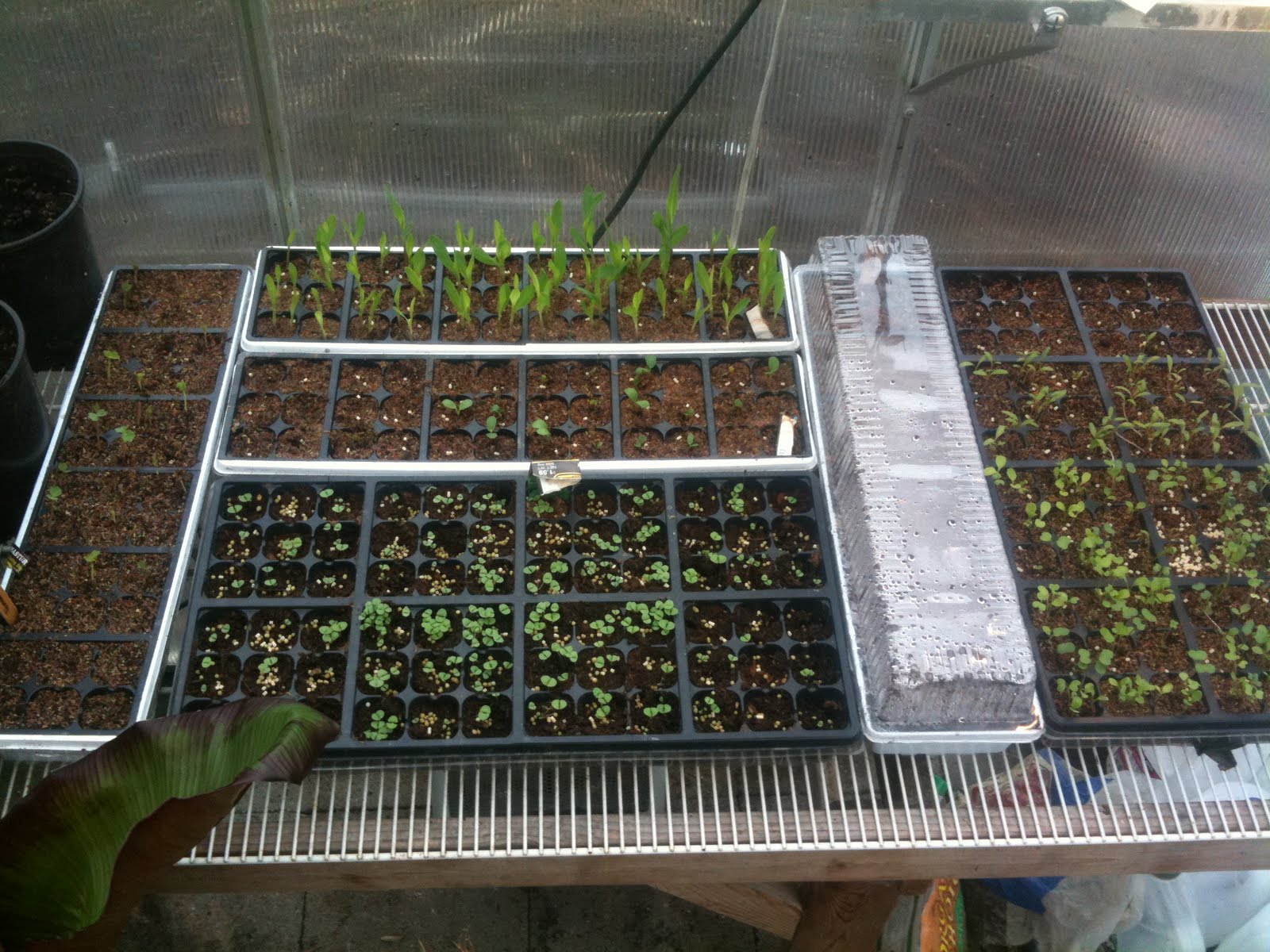
There are never enough seed trays at this time of year.


Growing in the tray below, from left to right, are some red bell peppers, English daisies, watermelon, walking stick kale, and carving pumpkins.  Also in the lower-right corner of this picture are three Berberis darwinii seedlings collected from the Arboretum. 

Monday, October 10, 2011

Ah, Poor Bird


October must be "Critter Calamity Month". After last week's fish fiasco, I was witness to the murder of this little sparrow, who didn't mind me getting up close to take his final picture. Moments after I had snapped the shot, Noel dashed out of nowhere and clenched the poor bird in his unrelenting jaws, escaping to the safety of underneath my car where he devoured his catch crunch by crunch. For an eight year old cat, he does pretty well at this.

The Acanthus mollis (Bear's breeches) below is approaching two full months in bloom.

Finally, one crop that did very well over the cool spring and summer were potatoes. Pictured below are Solanum tuberosum 'adirondack blue' and a white variety whose name is escaping me. The blue ones, by the way, have made excellent french fries. I dyed some of the white potatoes with red beet juice for the 4th of July and made red, white, and blue "freedom fries" which was a big hit to say the least. After doing some searching on the internet, I discovered red-fleshed potatoes. So next year's freedom fries will be 100% authentic and natural and not tampered with in any way - although maybe that's too un-American...

Monday, April 4, 2011

At least something likes the rain.

I guess one redeeming thing about this cold and wet spring is it is paradise for cool season crops like lettuce, spinach, peas, potatoes, Brussels sprouts, cauliflower & carrots. Even though they are growing fairly slowly in this cool & cloudy weather, they will be at their healthiest and most flavorful when they're ready to start harvesting in 3-6 weeks from now.

Below in the still-under-construction raised bed section of the garden, I've got growing (closest to farthest) some Adriondack blue potatoes (Solanum tuberosum 'adirondack blue'), spinach, cauliflower, & Brussels sprouts. I also have some snow peas sprouting up in the bed to the right (not in the picture).


Two weeks ago (in mid-March), I started the seedlings below in the greenhouse. They include: nasturtium (on the left), sweet corn (top center), lupin (center), lots & lots of basil (front center), carrots (under the plastic lid) and mesculin (right).