Monday, March 5, 2012

A Field Trip to Seattle University

Akebia trifoliata
It's not really a field trip...I am lucky enough to live only a couple blocks away from Seattle University, where they have an incredible selection of plants growing throughout their 48-acre campus.  Above, an Akebia trifoliata grows on an arbor at one of the school's main entrances.

Helleborus orientalis
Their selection of hellebores is fairly extensive.  Above, clumps of Helleborus orientalis are growing to perfection.

Iris foetidissima & Acanthus mollis
The evergreen leaves and red berries on Iris foetidissima give it a bit of a subtropical allure.  In the background is Acanthus mollis (Bear's breeches).


Daffodils blooming three weeks before the end of winter!

Helleborus argutifolius
This might look like a grouping of 10-15 separate hellebores, but the light-green flowered hellebore in the center of the picture is growing from one solitary clump.  It's giaganitc!  I believe it is a Helleborus argutifolius.  The Helleborus orientalis growing in the foreground is of normal size and shows just how big the other one is.

Juniperus chinensis 'Torulosa'
They have several very, very large Hollywood Junipers (Juniperus chinensis 'Torulosa').

Juniperus chinensis 'Torulosa'
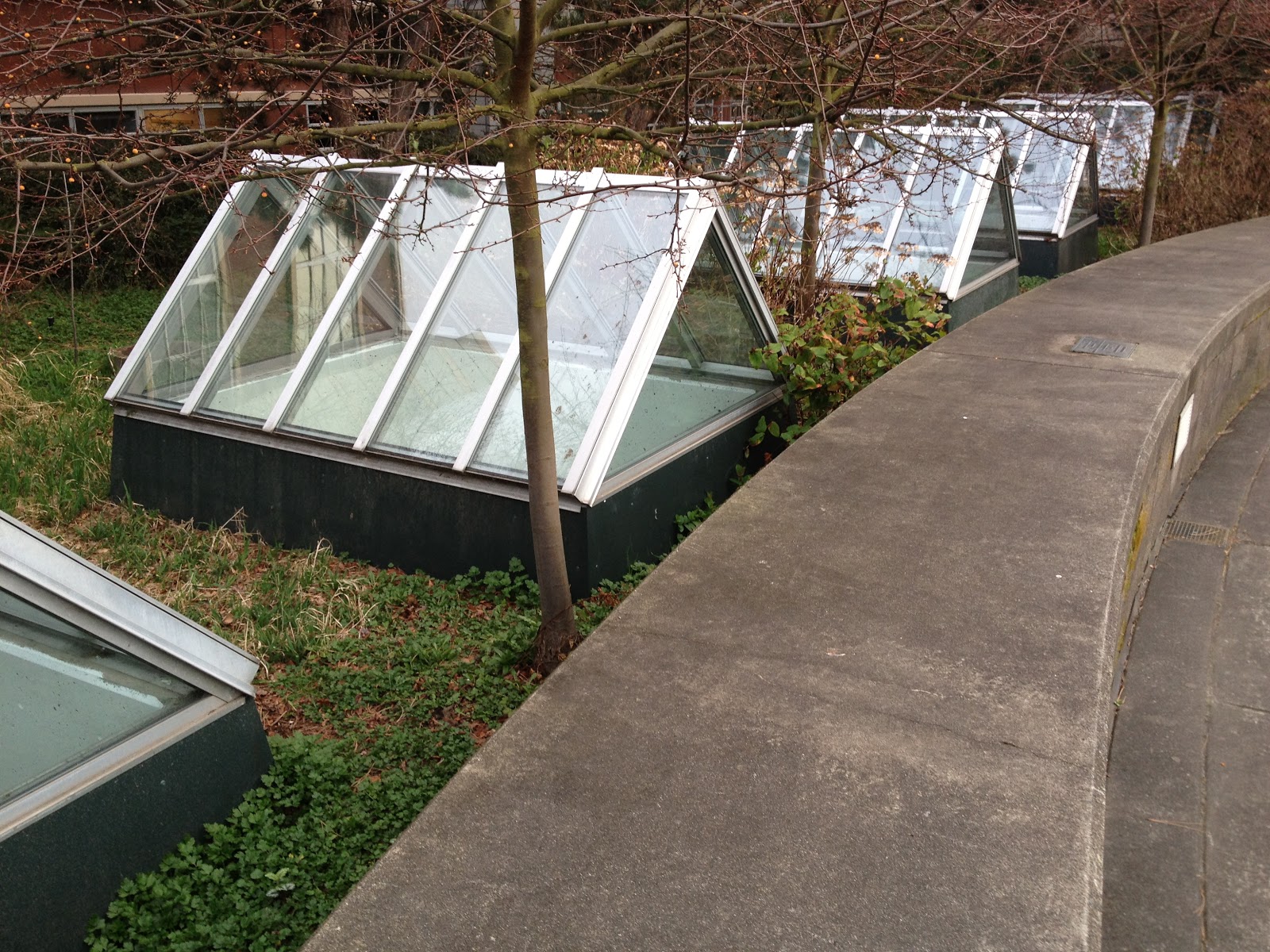
When I first saw these, I thought they were miniature greenhouses:


They are in fact skylights to an indoor corridor below, which makes this a green roof.  Look at the size of those pine trees - not bad for being on a roof! 


There were a number of azaleas in bloom all throughout the campus.

Finally, I was thinking how odd it was to have a rail going into grass, as if anyone needing a rail would want to walk around in the grass.  But I'm now realizing this is probably some artistic symbolism.  I thought the way the kept their grass with weeds and all was actually very attractive.

Saturday, March 3, 2012

Plants Waking Up Right Now


I don't know why this Sorbaria sorbifolia 'Sem' has decided it's a good idea to fully leaf out with a good deal of winter still left, but I am grateful that it takes the risk.  The red-tinged, translucent new growth glows in the sunlight, making this time of year its high season in terms of interest.  By summertime it fades into just another old shrub.


Euphorbias are such weird plants.  This Euphorbia characias is starting to shoot its chartreuse suction cup stalks toward the sky.


There is no such thing as having too many hellebores - especially black ones.


The cold-hardy banana (Musa basjoo) has sailed through this cold season without any protection.  The pseudo-stems are currently about 10' tall, so I'm hoping they will reach their full height of about 20' this summer.


Artichokes (Cynara cardunculus var. scolymus) make a great edible landscaping plant for us in the Northwest.  They should be grown in the perennial border as opposed to the vegetable garden.  The flowering stalks completely die down in the fall, but new rosettes of foliage resume growing from the roots and if the winter is mild like it was this year, they can be almost considered evergreen.  Few things grow as rapidly in our miserable March weather as artichokes.


Here is my pea scaffolding.  It's a bit wobbly, but anything made of bamboo and zip ties has to be indestructible, right?  There are some radishes to the right of the stepping stones that have already sprouted.


Finally, a shot of the rapidly emerging leaves of Cardiocrinum giganteum (Giant Himalayan lily).  This will be its third year, meaning 3-5 more years before blooming.

This Blog Is Now Famous!

None other than Far Reaches Farm has posted a link to my blog on their homepage.  Here is what they said about it:


Thank you Far Reaches Farm...I can't wait to check out your nursery this summer!

Monday, February 27, 2012

A Visit to Cistus Nursery

I made an impromptu stop at Cistus Nursery today after staying with some extended family in Oregon.  The nursery is located just outside of Portland on Sauvie Island.  Being three hours away from my house in Seattle, it's sort of a requirement for me to stop by if I'm ever driving through.


Cistus Nursery is a plant geek's nursery.  You won't find very many fruit trees or frilly flowers here.  Their specialty is in rare evergreen structural plants.  They grow plants like agaves, eucalyptus, palms, bamboo, ferns, cacti, yuccas, and perhaps the Northwest's best selection of hardy broadleaved evergreen trees.  In other words, they happen to grow all my most favorite plants.


Above, a pair of Yucca rostrata growing in a surprisingly high amount of shade. 

Below, I'm not quite sure of the plant on the left, but I know the plant on the right: an eryngium agavifolium.  Both look a bit miserable but they are also growing in a lot of shade and would probably look better in more sun.  At least they're growing in sandy/rocky soil.


Here is a nice Trachycarpus Fortunei (Windmill palm).  The new information on these is to partially bury the trunk when you plant them, since new roots can emerge from the trunk itself and extend its root system.  This palm is really unlike most other palms and thrives in our almost year-round wetness.


Here's an exciting idea: Pinnate or feather-leaved palms that can grow in the Northwest.  After all, when most people think of a palm tree, they're thinking of something that looks like this:

Butia capitata

A look inside the main greenhouse.  It is not an exaggeration to say that rare plants outnumber familiar plants.


I was checking out the palms when this scrappy old cat started stalking me.


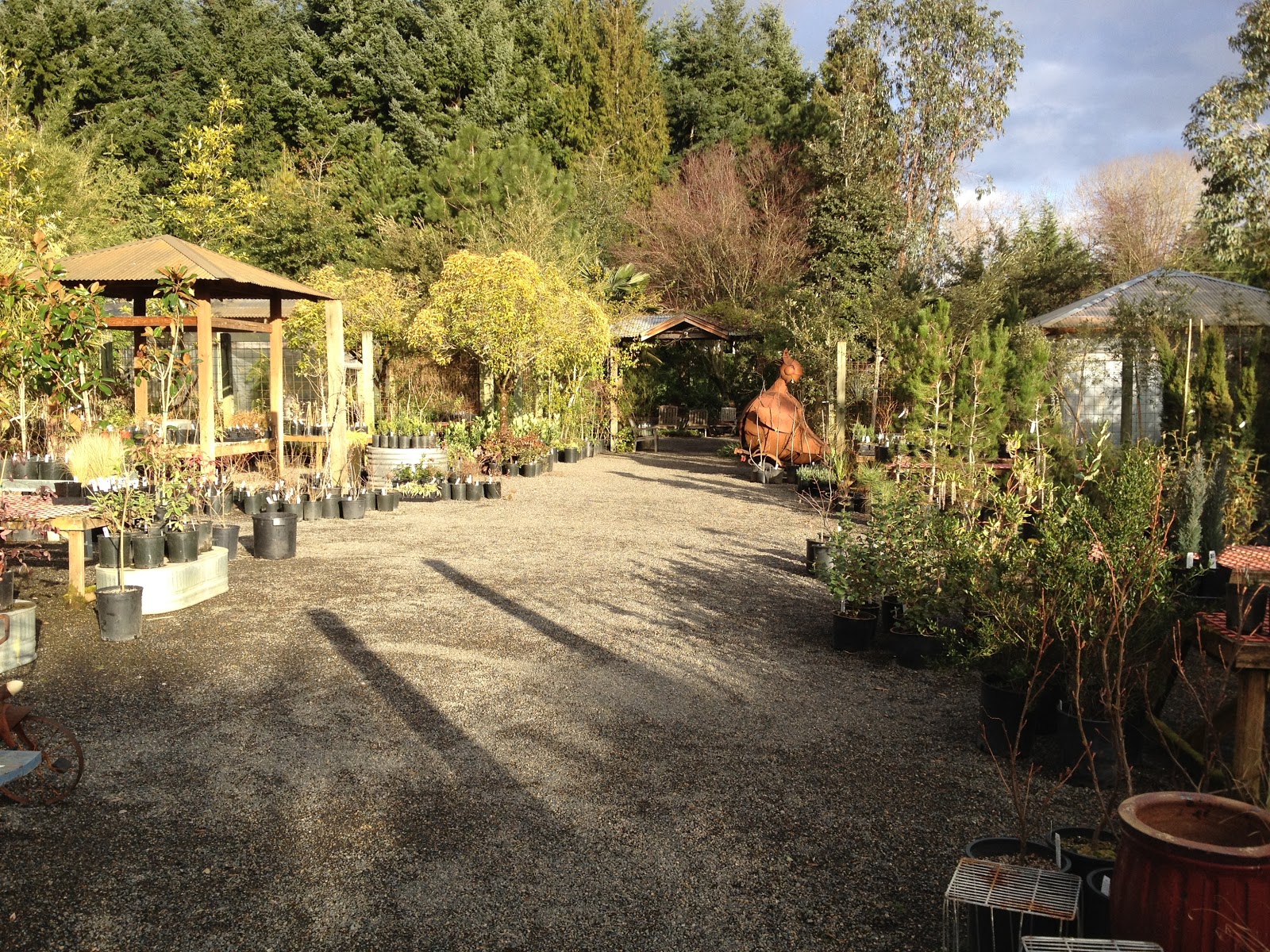
Here is an overall view of the nursery looking back toward the entrance.  As you can see, I had the place all to myself.


Psycho cat stalking me again as I was checking out these sedges.


Inside one of the greenhouses.  Their heating system does not seem to be very well advanced but I'm sure it does the trick.


The check-out area.  I have no idea what the plant is on the left.  It has the foliage of an echium but is branched like a tree.


Leaving Cistus Nursery without any plants is like leaving the beach without a suntan.  I quickly realized that a lot of money goes a little ways here.  But when you consider the time, effort, and resources it takes to obtain and propagate these incredible plants, it's actually a really good deal.


From left to right: 
Osmanthus armatus 'Jim Porter' - Very stiff, light green leaves with gold spikes
Podocarpus matudae - A large-leaved podocarpus
Chamaecyparis lawsonia 'Blue Surprise' - A Japanese conifer with blue foliage
Sophora microphylla 'Sun King' - An evergreen tree in the pea family
Cussonia paniculata - Just an odd-looking plant that will eventually form a trunk (not really hardy)
Magnolia laevifolia 'Velvet & Cream' - An incredibly handsome little tree
Agave parryi var. huachucensis - A blue agave with a good amount of cold and wet tolerance
Lonicera nitida 'Twiggy' - A little shrub with red and green foliage
Carex platyphylla 'Blue Satin' - A sedge with 1-2" wide, paper-thin foliage
Schefflera delavayi - One of the hardiest scheffleras
Pyrrosia lingua - A creeping evergreen fern with simple (i.e. non-ferny) leaves

Monday, February 20, 2012

Playing in the Mud


In the midst of dredging out the clay soil from underneath the good soil in the vegetable garden today, I made an interesting discovery.  Have you ever seen a worm this long?  It is at least 10 inches, maybe a couple more.  How do they burrow all the way down into that hard clay anyway?


As you can see in the above photo, I dug out the clay soil in order to effectively deepen the vegetable bed allowing for roots to grow deeper.  I surreptitiously relocated the useless clay by wheelbarrow to the city-owned greenway nearby.  In between wheelbarrow loads, I snacked on the kale and Brussels sprouts growing happily in our mild winter weather.  This year was my first time growing either of these.  Out of about 12 plants, I only had three Brussels sprouts that have done really well, with a large variability between the size of the plants and how well they formed closed sprouts.  I'm not really sure yet why some formed "open" sprouts while others - growing in the same conditions - formed perfectly closed sprouts like the one I'm holding.  But you can be sure I will get this fixed for next year...