Yesterday I had the pleasure of visiting Windcliff for the first time and Heronswood for the second time. I'd do a gigantic post about it if I wasn't getting ready for our 2nd annual Normandy Park Garden Festival next Saturday, July 6th, from 11-4 but after I recover I might. In the meantime, here are the plants I picked up:
Clockwise from back left:
Pittosporum tenuifolium 'County Park Dwarf' - Black foliage all year, new growth is bright green.
Osmunda regalis ‘Cristata’ - Royal crested fern. This is a great plant pick.
Phygelius capensis - Cape fuscia. More hummingbird food.
Clematoclethra hemsleyana var. akebioides DJSJ 3008 - A semi-evergreen vine.
Podophyllum delavayi - Finally! This has been on my wish list for way too long.
Urginea macrocarpa - Another odd & rare wonder from South Africa. The flowers resemble lilies.
Disporum cantoniense 'Green Giant' - Chinese Fairy Bells. Reaches 4' tall.
Friday, June 28, 2013
Monday, June 24, 2013
Getting Ready...
Today I picked up the fliers I'll be mailing out to our neighbors inviting them to the big garden festival on Sat. July 6th. Now begins the labeling, stuffing, sealing, stamping, and sending...
The garden is looking better than ever and I can't wait to show it off. I've been worried these stargazer lilies, which I'll be selling, would be past their prime by the time of the festival comes around. Now that I've moved them to the shade though they're growing slowly and should be looking and smelling incredible at the festival!
When the Phoenix canariensis (Canary Island Date Palm) I had for the past two years rotted out in the middle, I decided to replace it with something very similar but much better: Jubaea chilensis (Chilean Wine Palm). This palm is less susceptible to disease and will eventually become a 100-foot monster. When I saw this at Jungle Fever in Tacoma, I knew we were meant for each other. I also picked up a Musa sikkimensis and a Cornus capitata (Evergreen dogwood).
Although the veggie garden exists primarily to produce food, I am trying to get it to look picture perfect for the festival. Hopefully the peas will hang in there!
Of the several varieties of peas I grew this year, by far the best were the Oregon Sugar Pod II peas from Ed Hume seeds. Their pods are sweet, succulent and crunchy and don't seem to get the least bit stringy. The package said they climb to 3' but mine are 7' (those packages are hardly ever right). After the festival I'll be ripping them out and planting broccoli, cauliflower, and Brussels sprouts.
My first year growing fava beans is turning out to be a success. I can't wait to try them!
One of the best things about June is the abundance of strawberries. If you don't grow them you're missing out. I potted up about a dozen starts of these June-bearing strawberries and will be selling them at the festival.
Two bananas flowering at the same time!
Be sure to check out our garden festival on Sat. July 6th - it is going to be a lot of fun! Click here for more details.
The garden is looking better than ever and I can't wait to show it off. I've been worried these stargazer lilies, which I'll be selling, would be past their prime by the time of the festival comes around. Now that I've moved them to the shade though they're growing slowly and should be looking and smelling incredible at the festival!
When the Phoenix canariensis (Canary Island Date Palm) I had for the past two years rotted out in the middle, I decided to replace it with something very similar but much better: Jubaea chilensis (Chilean Wine Palm). This palm is less susceptible to disease and will eventually become a 100-foot monster. When I saw this at Jungle Fever in Tacoma, I knew we were meant for each other. I also picked up a Musa sikkimensis and a Cornus capitata (Evergreen dogwood).
![]() |
| Jubaea chilensis getting settled in its new home |
| Oregon Sugar Pod II Peas, planted on Feb 15th. |
My first year growing fava beans is turning out to be a success. I can't wait to try them!
One of the best things about June is the abundance of strawberries. If you don't grow them you're missing out. I potted up about a dozen starts of these June-bearing strawberries and will be selling them at the festival.
![]() |
| Musa basjoo |
Wednesday, May 15, 2013
Growing Rapidly
![]() |
| Tetrapanax papyrifer |
With ground-soaking rains in April, summer-like sunshine in the first half of May, and now back to rain, the garden seems to be changing by the hour.
![]() |
| Gunnera manicata |
| Fatsia polycarpa |
![]() |
| Strelitzia reginae |
Strelitzia reginae or Bird of paradise is a really good reason to have a greenhouse. It started blooming in March and should last into July. I bought this one a couple years ago and is now blooming for the first time. It doesn't have any major pests that I know of, although sometimes spider mites or aphids will feed off its leaves in the greenhouse, but a monthly spraying of neem oil solves that problem. I keep it outside April-October.
| Azalea 'White Lights' |
![]() |
| Clematis x cartmanii 'Blaaval' growing on the trunk of Trachycarpus fortunei |
![]() |
| Schefflera delavayi |
| Schefflera taiwaniana |
Sunday, May 12, 2013
It's Miller Time
I've visited Seattle's Elisabeth C. Miller in October, June, and now May. I have to say, in terms of the garden looking its best, May wins. Spring ephemerals and many rhododendrons are in bloom, freshly unfurled fronds festoon a flood of fine ferns, and having a nice and sunny mid-spring day, the thrust of the growing season kicking into high gear was spine-tingling.
I should mention before getting started I did already post a 3-part series on the Miller Garden last year, but considering the garden's many rare & exotic specimens, there is always plenty of new ground to cover...
Our group of about 10 was guided by the curator of the Miller Garden, Richie Steffen. I think he literally knows every plant in the garden.
I was amazed to discover we have a native fern that is evergreen and has gigantic 6'+ long fronds. It is called Woodwardia fimbriata or Giant chain fern. Its range is from northern California to southern British Columbia, making it hardy to at least 0 degrees F/-18C.
When woodpeckers started drilling into an old cedar tree next to Mrs. Miller's house, the garden's oversight board figured the tree was rotting from the inside out and decided to take it down. They had the trunk cut up in pieces and placed them around the garden. Just like in an old growth forest, the old rotting wood is making a new home for new generations of plants.
Paris polyphylla, a lily relative, is strikingly thin and elegant. It's cousin, Paris japonica, has the largest genome of any living organism (Its DNA sequence 50 longer than a human). Just thought I'd throw that in.
This is an evergreen fern called Blechnum novae-zelandiae. As its name implies, it's a New Zealand native. It makes a nice tall groundcover.
Borderline-hardy rhododendrons seem to work well in pots, where they can be carted under cover should a wintery arctic blast strike. This cultivar is called Rhododendron 'Walter Maynard'. Its giant white blossoms are very fragrant. I believe the garden has about 20 of these placed throughout the premises, each growing in a pot so it can be carted to safety should winter ever turn ugly.
I was straggling way behind when I took the above photo, otherwise I would have asked what the names of two plants were. Some kind of epimedium and eucomis? That's about as good as you're going to get from me....
Judging from the name, this hydrangea is a hybrid, but it was apparently collected by Dan Hinkley, who is a plant explorer and not really a hybridizer.
Of course the Miller garden is the type of place that would have mounds and mounds of Podophyllum delavayi. I've had many opportunities to buy this plant, but paying $50 for a root cutting is just not going to happen.
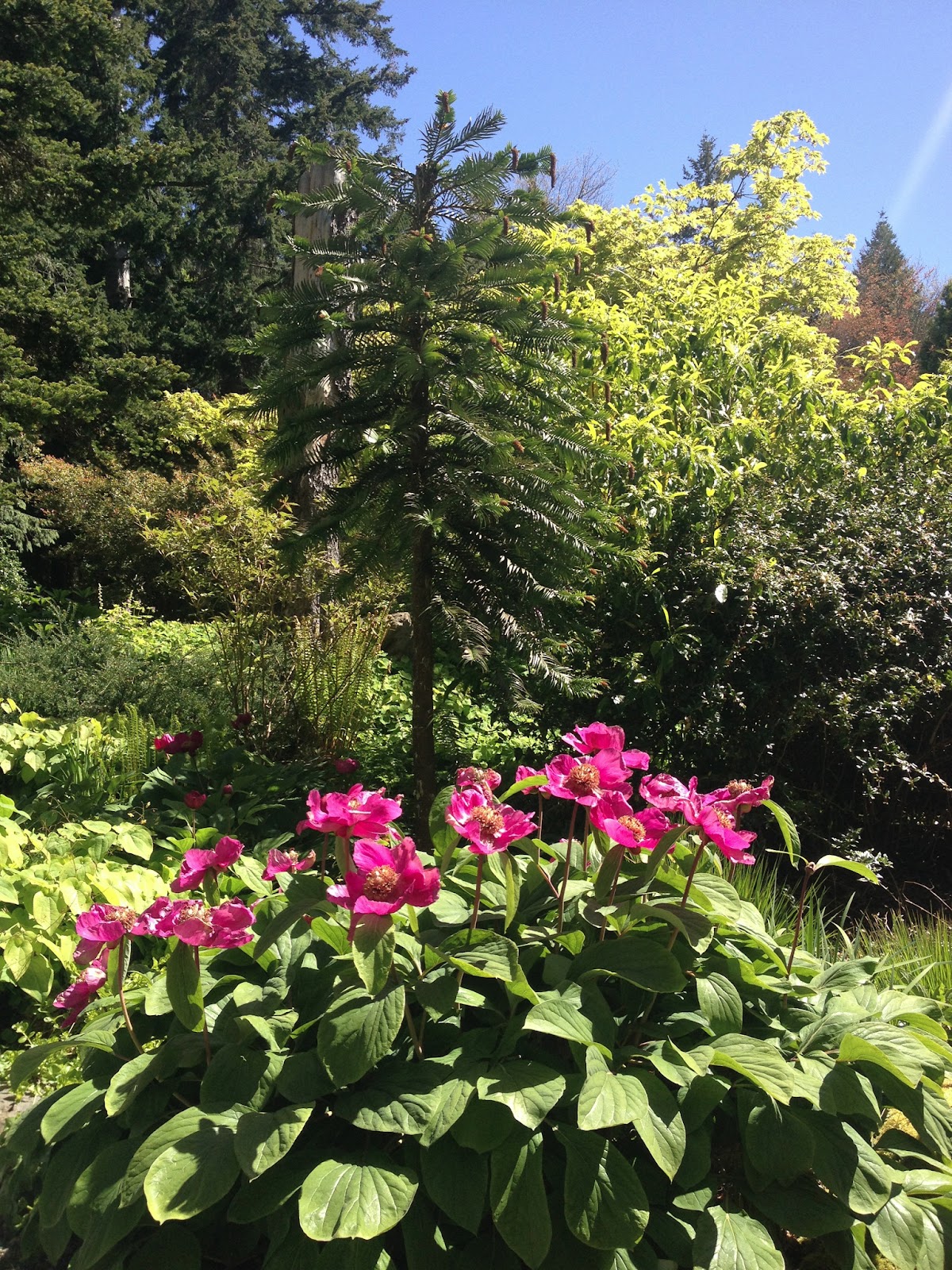
Behind these peonies (at least I think they're peonies) is one of their larger Wollemi pines. According to Steffen, the Miller Garden has the largest collection of Wollemi pines this far north.
And now for the best part. I saw how this papyrus was growing and suspected that it had overwintered in the ground. When I asked Richie about it, he said it was a hardy papyrus and had been growing there for several years. Right at that point, I heard the sound of trumpets echoing in the heavens as I entered into a new stage of enlightenment. Hardy papyrus? How did I not know about this before?!?!? They are in the genus Cyperus but the species name is unknown. To my utter amazement and forever indebtedness, when we finished our tour, I was handed a 1 gallon specimen to take home. Richie told me how to propagate it from leaf nodules...so at some point I just might have some to share!
Now some bad news: The Miller Garden is already sold out for 2013 but check their website in September or sign up for a Northwest Horticultural Society class at the Miller Garden to try for a spot in 2014. With a bit of initiative, it's pretty easy to be one of the 500 guests allowed into the garden each year.
I should mention before getting started I did already post a 3-part series on the Miller Garden last year, but considering the garden's many rare & exotic specimens, there is always plenty of new ground to cover...
| An overall view of the garden. |
| Heading into the dense, wooded area of the garden. |
| Woodwardia fimbriata (Giant chain fern) |
When woodpeckers started drilling into an old cedar tree next to Mrs. Miller's house, the garden's oversight board figured the tree was rotting from the inside out and decided to take it down. They had the trunk cut up in pieces and placed them around the garden. Just like in an old growth forest, the old rotting wood is making a new home for new generations of plants.
![]() |
Paris polyphylla
|
![]() |
| Plants of different shapes, textures, and shades of green create living tapestries. |
| Blechnum novae-zelandiae |
![]() |
| Rhododendron 'Walter Maynard' |
I was straggling way behind when I took the above photo, otherwise I would have asked what the names of two plants were. Some kind of epimedium and eucomis? That's about as good as you're going to get from me....
![]() |
| Hydrangea aspera 'Plum Passion' |
![]() |
| Bonsai wisteria? |
![]() |
| Rhododendron makinoi? |
| Podophyllum 'Spotty Dotty', among others |
![]() |
| Podophyllum 'Kaleidoscope' |
| Arisaema griffithii |
![]() |
| Wollemia nobilis |
![]() |
| Dicksonia antarctica (Tasmanian tree fern) in the background. I'm not sure what the plant with white flowers is. Could be a hardy orchid perhaps. |
| They had a schefflera, not sure of the species |
![]() |
| Podophyllum pleianthum |
| Rheum palmatum var. tanguticum |
![]() |
| Their greenhouse is way too empty... |
![]() |
| Cyperus sp. (Possibly Cyperus glaber) |
Now some bad news: The Miller Garden is already sold out for 2013 but check their website in September or sign up for a Northwest Horticultural Society class at the Miller Garden to try for a spot in 2014. With a bit of initiative, it's pretty easy to be one of the 500 guests allowed into the garden each year.
Wednesday, May 8, 2013
Cool Combos
Green, yellow and black can make for a pretty ugly American flag, but these three colors play really well off each other in this section the garden. It started out as a Japanese area with no regard to color, but I soon took notice and quickly moved some plants around to enhance the continuity of this color scheme.
Hues ranging from bright yellow to dark green are represented, as is the year-round black provided by black mondo grass (Ophiopogon planiscapus 'Nigrescens'). One of my favorite Japanese maples, Acer palmatum 'Orange Dream', has reddish orange tips on its leaves but is mostly bright yellow. There is also a tiny bit brown and white in this area, but in the same way skyscrapers are prohibited within the city limits of Paris, red, pink, blue, purple and silver are not allowed (mostly).
Another great combo: The upright racemes of the Empress tree (Paulownia tomentosa) coupled with the slightly darker purple pendulous racemes of Chinese wisteria (Wisteria sinensis). Both plants bloom at the same time, just as their leaves are starting to emerge, their verticality connecting the sky with the earth.
An edible combo that grows incredibly well in our cool & wet springs: Peas, spinach & dill.
And finally, mixing the living with the non-living: Stones & Soleirolia soleirolii (Baby's tears)
Hues ranging from bright yellow to dark green are represented, as is the year-round black provided by black mondo grass (Ophiopogon planiscapus 'Nigrescens'). One of my favorite Japanese maples, Acer palmatum 'Orange Dream', has reddish orange tips on its leaves but is mostly bright yellow. There is also a tiny bit brown and white in this area, but in the same way skyscrapers are prohibited within the city limits of Paris, red, pink, blue, purple and silver are not allowed (mostly).
Another great combo: The upright racemes of the Empress tree (Paulownia tomentosa) coupled with the slightly darker purple pendulous racemes of Chinese wisteria (Wisteria sinensis). Both plants bloom at the same time, just as their leaves are starting to emerge, their verticality connecting the sky with the earth.
An edible combo that grows incredibly well in our cool & wet springs: Peas, spinach & dill.
And finally, mixing the living with the non-living: Stones & Soleirolia soleirolii (Baby's tears)
Subscribe to:
Posts (Atom)


