Friday, February 17, 2012

Under Cover


Being a Seattle native, I usually don't notice it's raining until my hair is soaking wet and water starts dripping down my face.  Today was one of those "soaking" days in Seattle, so I was limited to working in the increasingly cramped greenhouse in order to stay dry.


When I opened the door, I was welcomed by some very aggressive castor bean seedlings trying to rip the roof off of their seed tray.

Last April, I bought 100 red-leaved castor bean seeds (Ricinus communis) from an online retailer and planted them in the ground.  About 10 of those plants went on to produce viable seed - an amazing feat considering the cold spring and cool summer we had.  I cut the flower stalks off in mid-November and hung them upside-down in the greenhouse where they became fully ripe around Thanksgiving.  I then spent two hours removing the poisonous beans by hand from their spiky pods.   Here's a picture I took in November:


In all, I managed to get about 300 beans.  I placed them in a manila envelope, stuck them in the garage, and mostly forgot about them until two weeks ago when I thought I should try to germinate some.

Well, here's what 14 days of bottom heat, moisture, and some seed starter mix do to a castor bean seed.  Pretty amazing.


I also started some Brussels sprouts & Cauliflower, pictured below.  They were planted on Feb. 4th.


The first picture in this posting shows a variegated lemon tree (Citrus limon 'Pink Lemonade') with - oddly enough - variegated fruit as well as leaves.  The picture below is of the same plant and shows the pink tinge in the plant's new growth.  The inside of the fruit is also pink.  It certainly makes a great potted plant for the greenhouse in winter and outside in the summer.


Sometimes growing diagonally is a necessity.  This bird of paradise (Strelitzia reginae) is getting too big to fit in the greenhouse!


Sparkler sedge (Carex phyllocephala 'Sparkler') seedlings.


Finally, my blue agave (Agave tequilana) is starting to put on some new growth.  Other than watering it once on Christmas day, it hasn't been watered since October.


Thursday, February 16, 2012

New Plants!!!!


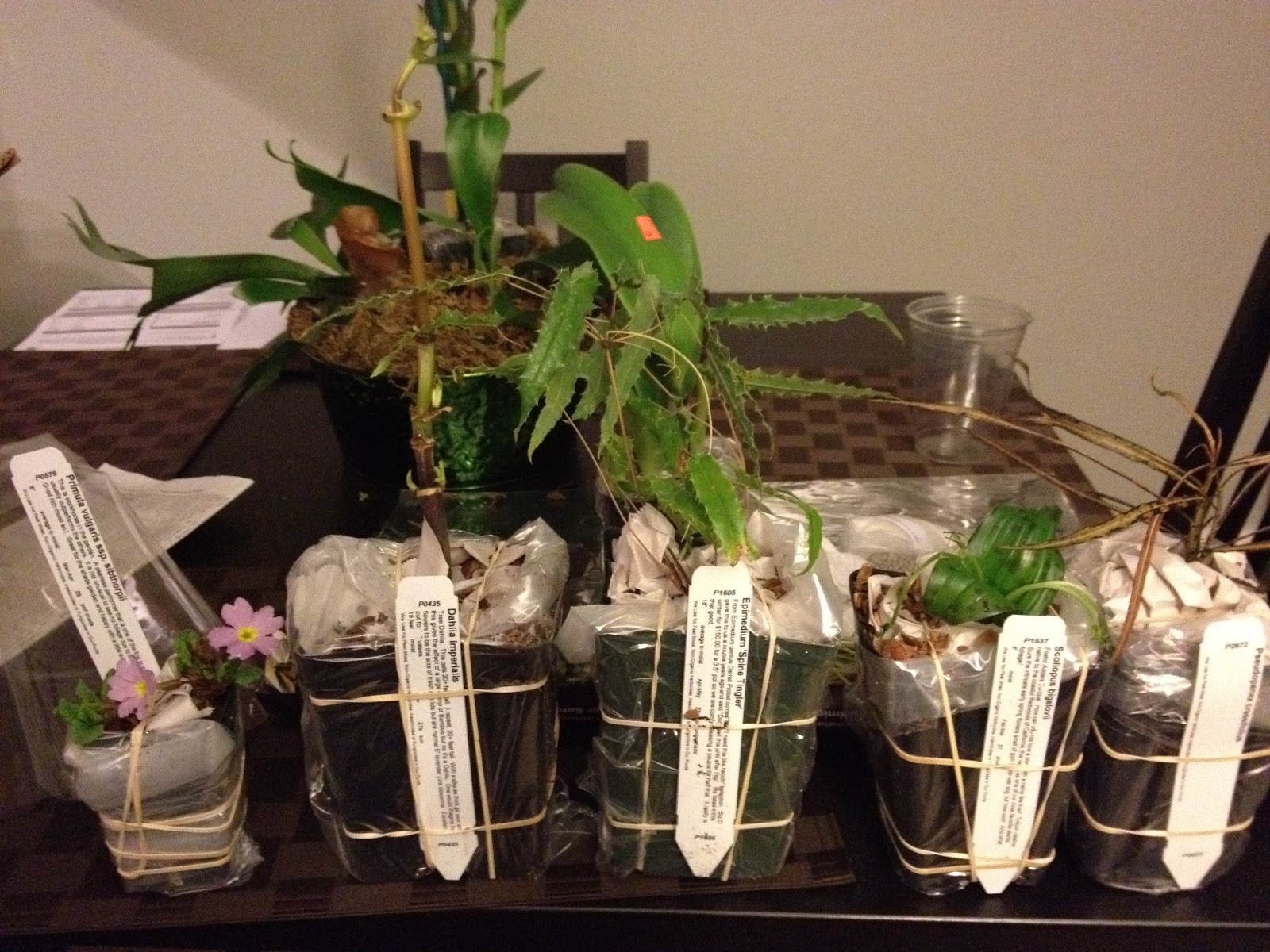
My Far Reaches Farm order arrived today...I frantically opened it before I remembered what I got.  Inside, I found many wonderful plants:


From left to right: A bonus Primula vulgaris ssp. sibthorpii, Dahlia imperialis - a 20' tall dahlia, Epimedium 'Spine Tingler' - an evergreen epimedium with spiky foliage, Scoliopus bigelovii - a trillium relative with really interesting looking flowers which supposedly smell like a wet dog, and Pseudopanax crassifolius - a half-hardy tree with long strappy black leaves pointing toward the ground.

Wednesday, February 15, 2012

Signs of Spring


Temperatures this winter in Seattle have not gone below 26 degrees (from November up til now). This means it has been one of the mildest winters in recent memory around here.  Yes, there's over a month to go until spring, but the forecast for the next 10 days is rain, and it has never fallen below 25 degrees after that, so I think it is safe to say that we're out of the "arctic woods" for this year.


We also managed to hit 60 degrees for three days in a row toward the beginning of the month - something that has never happened at this time of year before.  This was a wake-up call for rhubarb and tulips, which have been putting on significant growth since then.

Even the fish are starting to become more active.


I'm getting the vegetable garden ready one section at a time.  Here, some bamboo scaffolding is under construction with some freshly planted sugar snap peas beneath it.


A lupin demonstrating surface tension.


And finally a Euphorbia characias 'Glacier Blue' preparing to bloom.


Winter Bloomers

As spring slowly approaches, many winter-blooming plants are still going strong.  Daphne bhoula has been in bloom for the past month.  Like many winter-blooming plants, it has a very intense fragrance.


This yellow Witch Hazel (Hamamelis intermedia) is currently in peak-bloom while the orange variety on the other side of the garden has dropped most of its petals.

  
After three years of seeing the buds freeze off, Camellia sasanqua 'Apple Blossom' has finally burst into bloom.  The flowers don't look anything like apple blossoms...they're much bigger!!


A few naturalized Cyclamen coum seedlings.


Mahonia x media 'Charity' is also blooming right now.  I've seen a few hummingbirds visit this one.  Unfortunately, they're always off to the next plant by the time I get my camera out.


And finally, if you're going to grow one plant in February, it should be a hellebore.  This genus keeps getting better every year thanks to the many Hellebore breeders out there.  Shown are Helleborus orientalis & Helleborus niger.

Monday, February 13, 2012

The Northwest Flower & Garden Show, Part 3


The best thing about the Northwest Flower & Garden Show is what's not there: homes.  I've been to other "Home and Garden" shows that are 90% home and 10% garden.  Gardens are merely an afterthought there.  But here, gardens take center stage and homes are the afterthought.  That's the way it should be.

The Tasmanian tree fern (Dicksonia antarctica) in this picture signifies that tree ferns don't particularly relish bonsai life.  I'm sure it would be much happier in the ground, with protection from the occasional major frost we get around here.


Did you know that primroses are edible?


Here's an economical idea for a "vertical garden" - an old pallet board.  How cool would it be to have a fence made out of these.  There is sort of an ugliness factor to it though.


I also just wanted to mention that I stopped by the Northwest Horticultural Society's booth to purchase tickets for "Plant Nerd Night" in April, only to be dismayed when I saw that they were all sold out.  After refusing to accept "All sold out" for an answer, the lady there said I could volunteer, in which case I could get in for free!  Sounds like a plan!

To wrap things up, I'll end with the seminars - the best part about the show in my opinion.


I summarized the first seven seminars two posts back, and here I will summarize the remaining five:

"Organic Gardening for Everyone" by Charlie Nardozzi.  Charlie started out by discussing the clever tactics the food industry uses to trick us into thinking we're buying something completely organic even though we might not be.  Buying something that says "Organic" isn't the same thing as buying something that says "100% organic".  According to the USDA, a product can contain only 95% organic ingredients and still call itself organic(!).  "Made with Organic Ingredients" is even worse.  It only has to contain at least 70% organic ingredients.  "Natural" is pretty much meaningless.  He noted the resurgence of urban homesteaders in recent years and went on to discuss ways to grow vegetables organically.  One tip that I had never heard before: placing red plastic under tomatoes has been shown to increase the yield by 20% or more.  He said that celery contains the highest concentration of pesticides out of any store-bought vegetable, so grow your own celery.

"E.G.G.S. - Eat.  Grow.  Gather.  Share." by Graham Kerr.  The Galloping Gourmet was before my time, but Graham Kerr's charisma and enthusiasm for gardening at age 78 is enough to make me a fan.  He has always been a world-class chef, but up until four years ago, all the ingredients he used were from other people's gardens.  Now he is gardening full-time and starting clubs around the country where neighbors share vegetables with each other.

"Growing A Greener World" by Joe Lamp'l.  I had never heard of Joe Lamp'l before, but he seems to be very in tune with what gardeners are up to around the Northwest.  He talked about things people are doing to conserve the environment through gardening.  He was particularly fond of us recycling food scraps and yard waste into Cedar Grove Compost.  At one point they showed him diving into a fresh pile of the stuff.

"Bring it On!" by Ciscoe Morris.  Ciscoe talked about plants that are easy to grow and won't succumb to our harshest winter.  A couple plants that stood out to me included Daphne houtteana, a daphne with purplish-black leaves, Astrantia major 'Hadspen Blood', which is rumored to repel slugs and snails from the area, and Dactylorhiza x grandis, a hardy orchid with purple flowers.

"Creating Drama & Mystery in the Garden" by Nicholas Staddon.  Nicholas is the Director of New Plant Introductions for Monrovia.  That sounds like a pretty cool job title to me.  Most of the "new" plants he talked about I was already familiar with, however there were a few that I was not aware of.  Hosta 'Empress Wu' is perhaps the largest hosta - with its leaves growing to 6' tall!  How cool!  And its hardy to zone 3!  He also discussed a new, purple-leaved hydrangea that Monrovia will be rolling out next year.


So there you have it.  My take on the 2012 Northwest Flower & Garden Show.  If you live in the Northwest, maybe I'll see you at next year's show.  If you don't live in the Northwest, be sure to visit your local garden show and support the horticultural community in your area!