Monday, February 27, 2012

A Visit to Cistus Nursery

I made an impromptu stop at Cistus Nursery today after staying with some extended family in Oregon.  The nursery is located just outside of Portland on Sauvie Island.  Being three hours away from my house in Seattle, it's sort of a requirement for me to stop by if I'm ever driving through.


Cistus Nursery is a plant geek's nursery.  You won't find very many fruit trees or frilly flowers here.  Their specialty is in rare evergreen structural plants.  They grow plants like agaves, eucalyptus, palms, bamboo, ferns, cacti, yuccas, and perhaps the Northwest's best selection of hardy broadleaved evergreen trees.  In other words, they happen to grow all my most favorite plants.


Above, a pair of Yucca rostrata growing in a surprisingly high amount of shade. 

Below, I'm not quite sure of the plant on the left, but I know the plant on the right: an eryngium agavifolium.  Both look a bit miserable but they are also growing in a lot of shade and would probably look better in more sun.  At least they're growing in sandy/rocky soil.


Here is a nice Trachycarpus Fortunei (Windmill palm).  The new information on these is to partially bury the trunk when you plant them, since new roots can emerge from the trunk itself and extend its root system.  This palm is really unlike most other palms and thrives in our almost year-round wetness.


Here's an exciting idea: Pinnate or feather-leaved palms that can grow in the Northwest.  After all, when most people think of a palm tree, they're thinking of something that looks like this:

Butia capitata

A look inside the main greenhouse.  It is not an exaggeration to say that rare plants outnumber familiar plants.


I was checking out the palms when this scrappy old cat started stalking me.


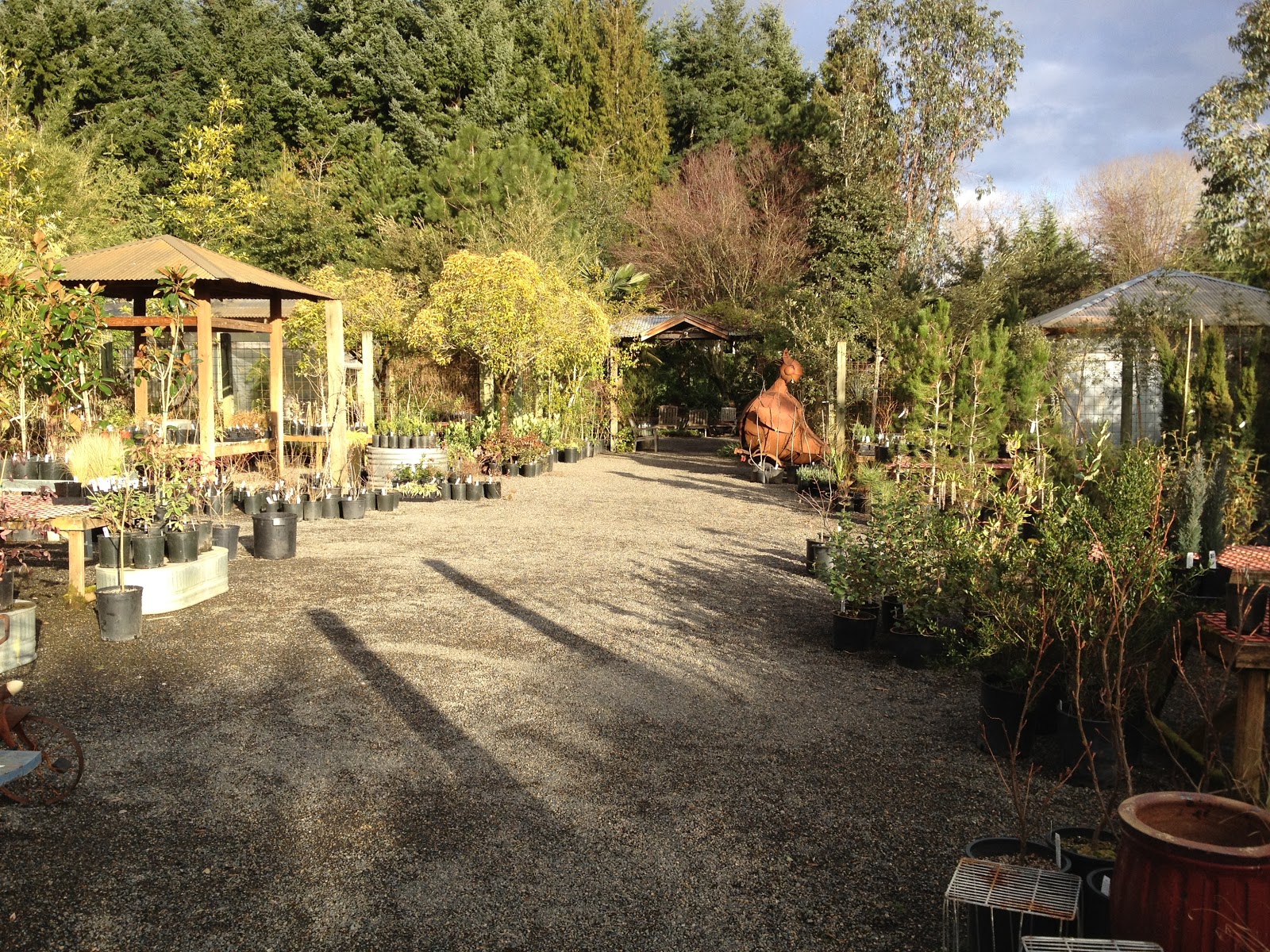
Here is an overall view of the nursery looking back toward the entrance.  As you can see, I had the place all to myself.

Psycho cat stalking me again as I was checking out these sedges.


Inside one of the greenhouses.  Their heating system does not seem to be very well advanced but I'm sure it does the trick.


The check-out area.  I have no idea what the plant is on the left.  It has the foliage of an echium but is branched like a tree.


Leaving Cistus Nursery without any plants is like leaving the beach without a suntan.  I quickly realized that a lot of money goes a little ways here.  But when you consider the time, effort, and resources it takes to obtain and propagate these incredible plants, it's actually a really good deal.


From left to right: 
Osmanthus armatus 'Jim Porter' - Very stiff, light green leaves with gold spikes
Podocarpus matudae - A large-leaved podocarpus
Chamaecyparis lawsonia 'Blue Surprise' - A Japanese conifer with blue foliage
Sophora microphylla 'Sun King' - An evergreen tree in the pea family
Cussonia paniculata - Just an odd-looking plant that will eventually form a trunk (not really hardy)
Magnolia laevifolia 'Velvet & Cream' - An incredibly handsome little tree
Agave parryi var. huachucensis - A blue agave with a good amount of cold and wet tolerance
Lonicera nitida 'Twiggy' - A little shrub with red and green foliage
Carex platyphylla 'Blue Satin' - A sedge with 1-2" wide, paper-thin foliage
Schefflera delavayi - One of the hardiest scheffleras
Pyrrosia lingua - A creeping evergreen fern with simple (i.e. non-ferny) leaves

Monday, February 20, 2012

Playing in the Mud


In the midst of dredging out the clay soil from underneath the good soil in the vegetable garden today, I made an interesting discovery.  Have you ever seen a worm this long?  It is at least 10 inches, maybe a couple more.  How do they burrow all the way down into that hard clay anyway?


As you can see in the above photo, I dug out the clay soil in order to effectively deepen the vegetable bed allowing for roots to grow deeper.  I surreptitiously relocated the useless clay by wheelbarrow to the city-owned greenway nearby.  In between wheelbarrow loads, I snacked on the kale and Brussels sprouts growing happily in our mild winter weather.  This year was my first time growing either of these.  Out of about 12 plants, I only had three Brussels sprouts that have done really well, with a large variability between the size of the plants and how well they formed closed sprouts.  I'm not really sure yet why some formed "open" sprouts while others - growing in the same conditions - formed perfectly closed sprouts like the one I'm holding.  But you can be sure I will get this fixed for next year...


Friday, February 17, 2012

Under Cover


Being a Seattle native, I usually don't notice it's raining until my hair is soaking wet and water starts dripping down my face.  Today was one of those "soaking" days in Seattle, so I was limited to working in the increasingly cramped greenhouse in order to stay dry.


When I opened the door, I was welcomed by some very aggressive castor bean seedlings trying to rip the roof off of their seed tray.

Last April, I bought 100 red-leaved castor bean seeds (Ricinus communis) from an online retailer and planted them in the ground.  About 10 of those plants went on to produce viable seed - an amazing feat considering the cold spring and cool summer we had.  I cut the flower stalks off in mid-November and hung them upside-down in the greenhouse where they became fully ripe around Thanksgiving.  I then spent two hours removing the poisonous beans by hand from their spiky pods.   Here's a picture I took in November:


In all, I managed to get about 300 beans.  I placed them in a manila envelope, stuck them in the garage, and mostly forgot about them until two weeks ago when I thought I should try to germinate some.

Well, here's what 14 days of bottom heat, moisture, and some seed starter mix do to a castor bean seed.  Pretty amazing.


I also started some Brussels sprouts & Cauliflower, pictured below.  They were planted on Feb. 4th.


The first picture in this posting shows a variegated lemon tree (Citrus limon 'Pink Lemonade') with - oddly enough - variegated fruit as well as leaves.  The picture below is of the same plant and shows the pink tinge in the plant's new growth.  The inside of the fruit is also pink.  It certainly makes a great potted plant for the greenhouse in winter and outside in the summer.


Sometimes growing diagonally is a necessity.  This bird of paradise (Strelitzia reginae) is getting too big to fit in the greenhouse!


Sparkler sedge (Carex phyllocephala 'Sparkler') seedlings.


Finally, my blue agave (Agave tequilana) is starting to put on some new growth.  Other than watering it once on Christmas day, it hasn't been watered since October.


Thursday, February 16, 2012

New Plants!!!!


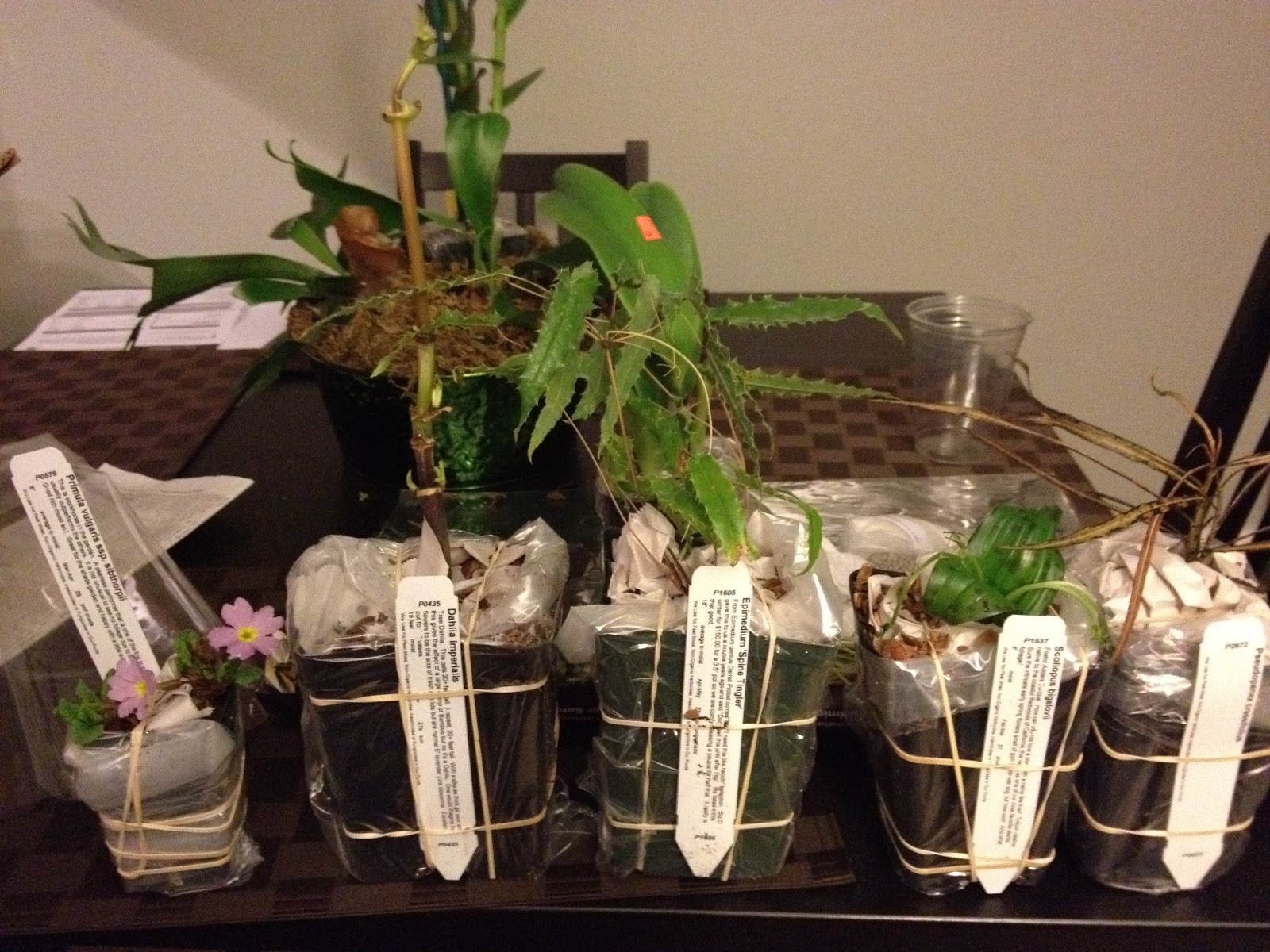
My Far Reaches Farm order arrived today...I frantically opened it before I remembered what I got.  Inside, I found many wonderful plants:


From left to right: A bonus Primula vulgaris ssp. sibthorpii, Dahlia imperialis - a 20' tall dahlia, Epimedium 'Spine Tingler' - an evergreen epimedium with spiky foliage, Scoliopus bigelovii - a trillium relative with really interesting looking flowers which supposedly smell like a wet dog, and Pseudopanax crassifolius - a half-hardy tree with long strappy black leaves pointing toward the ground.

Wednesday, February 15, 2012

Signs of Spring


Temperatures this winter in Seattle have not gone below 26 degrees (from November up til now). This means it has been one of the mildest winters in recent memory around here.  Yes, there's over a month to go until spring, but the forecast for the next 10 days is rain, and it has never fallen below 25 degrees after that, so I think it is safe to say that we're out of the "arctic woods" for this year.


We also managed to hit 60 degrees for three days in a row toward the beginning of the month - something that has never happened at this time of year before.  This was a wake-up call for rhubarb and tulips, which have been putting on significant growth since then.

Even the fish are starting to become more active.


I'm getting the vegetable garden ready one section at a time.  Here, some bamboo scaffolding is under construction with some freshly planted sugar snap peas beneath it.


A lupin demonstrating surface tension.


And finally a Euphorbia characias 'Glacier Blue' preparing to bloom.