Sunday, April 8, 2012

Four Years Later...

It took me four years, 18 tons of concrete, 1,000 linear feet of rebar, and several hundred rocks to build the 3,000 gallon koi pond in the backyard.  If there were a makeover TV show for backyards, this would be the extreme version of it.  Here are just a few before and after shots of the project:

Before: May 2008; After: April 2012


Before: July 2008; After: April 2012

Before: November 2008; After: April 2012

Friday, April 6, 2012

Exciting News!


If you live in the Normandy Park area, be sure to save the date of Saturday, July 7th, 2012.  My parents and I will be hosting a "Garden Festival & Plant Sale" at their house in Normandy Park.  Special guest Dan Hinkley will be giving a talk at 1:30pm and he will even be bringing some of his own plants to sell as well (yippee!).  Of course, you'll be able to roam around the garden to your heart's content while munching on a few light refreshments.  This event is free and open to the public.

If you would like to RSVP, you can e-mail me at:

More info on this to come soon!

Wednesday, April 4, 2012

The Little Season That Could


Today's post is brought to you by the number five.  That's how many degrees below and inches of rain above normal it was for the month of March.  April is looking to be slightly less ornery, but let's not get our hopes up. 

Melianthus major (Honey Bush)
At the NW Flower & Garden Show in February, one of the speakers (an executive from Monrovia I believe) said he had yet to see a Melianthus major go to flower in the Northwest.  Well, have I got news for him.  Not only did mine bloom last summer, but it's about to bloom again!


One thing that has been growing incredibly fast lately is the kale in the garden.  This couldn't have been a better winter for cole crops - cool, rainy, and mild.

Hepatica nobilis
Hepaticas...how can something so pristine emerge out of soil that's so wet and murky?


Some radishes, on the left, are off to a great start and should be ready to eat in a couple weeks.  The peas, on the other hand, are not.  Only two peas emerged from the soil.  I dug through to see what the problem was, and they were all gone!  Something's eating them...no clue what though.

Berberis darwinii (Darwin Barberry)
Thanks to a mild winter, this evergreen barberry has been in bloom since November and doesn't show any sign of stopping.

Dicentra (Bleeding Heart)

Tuesday, April 3, 2012

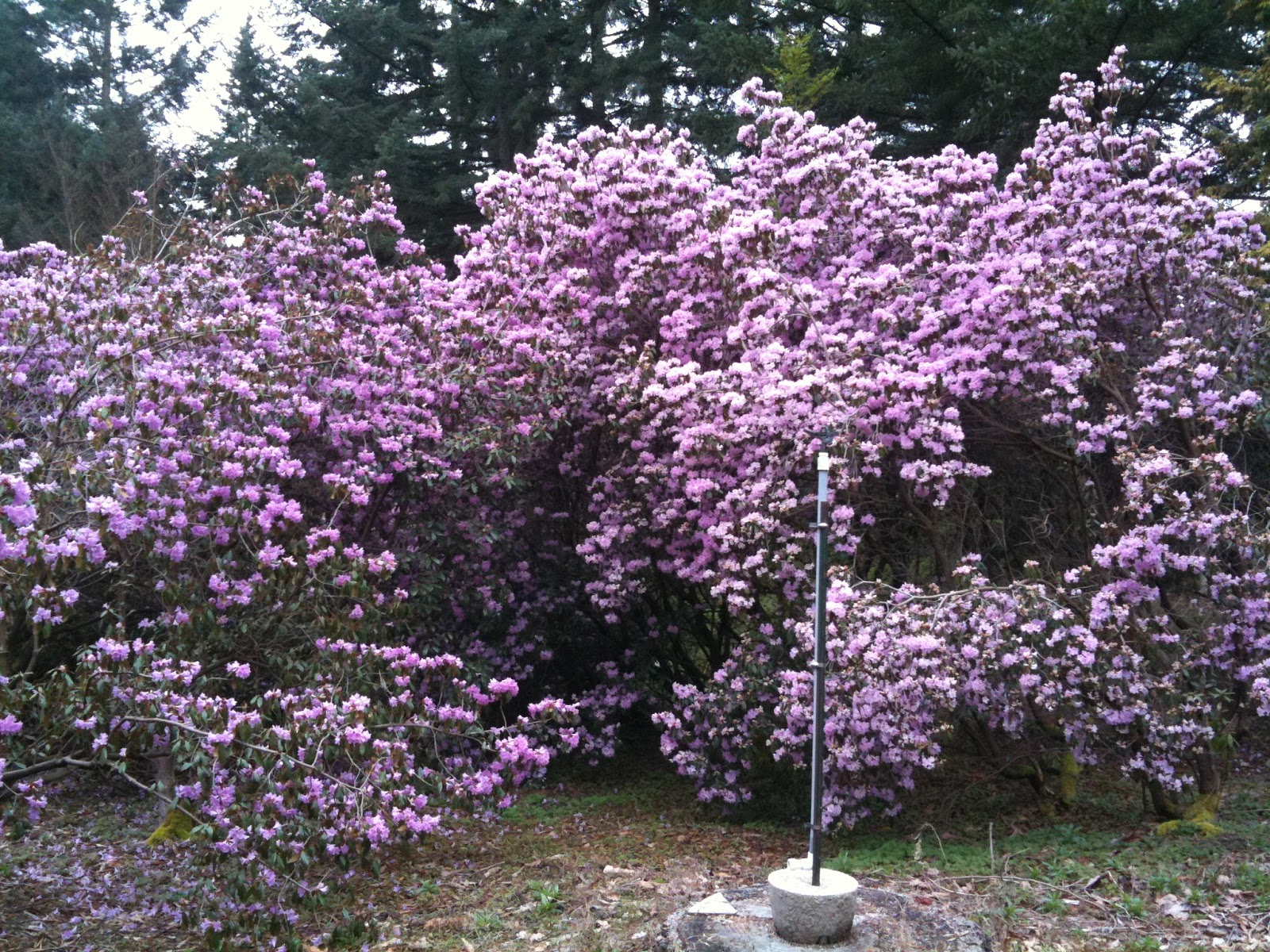
Rhododendron Time Machine

Rhododendron kesangiae
The pictures in this post today are from exactly two years ago - April 3rd, 2010.  They are all from the Rhododendron Species Garden in Federal Way.  There, I discovered a few great plants including this stunner:
Cardiocrinum giganteum (Giant Himalayan Lily)
I probably would have walked right past this plant if it hadn't been for the 10' tall old flower stalks still hanging around from the previous year.  What perennial shoots a flower stalk 10 feet into the air?  When I walked back to the plant store at the entrance, not only did they know exactly what I was talking about, they also had a few for sale.  Of course I bought one.  I should have bought more.

Matteuccia struthiopteris (Ostrich fern)
I had seen Ostrich ferns before, but never naturalized like this.  They all seem to be unfurling their fronds at exactly the same rate.

Rhododendron sinogrande
It was fairly apparent, judging mostly by the leaf damage, that this king of all large-leaved rhododendrons had endured the relatively cold winter of 2009-2010.  I don't know how or even if they protected it, but if it made it through that winter, it certainly has a lot of potential in the Northwest.

Erythronium revolutum
Usually you have to wait until the summer if you want to see lilies (at least growing outside naturally), but these lilies are doing their thing right at the beginning of spring.

Finally, the rhododendrons in this last picture form a conglomerate about the same size as an average 2-story suburban house.

Sunday, April 1, 2012

Gardening Australia Returns!


Gardening Australia is the best gardening show in the world.  This year they apparently have a new host with a freakishly long beard.  I'm not sure why they got rid of the old host, Stephen Ryan.

An interesting tidbit (I'm already thinking Australian) about the show is the fact that the seasons are reversed: they are heading into winter while we are heading into summer.  Of course, their winter temperatures aren't too far off from our summer temperatures in Seattle.  Up in the northern tropical Australia, they explain how the wet and dry seasons affect when they can grow certain things.

A big overall theme of the show is growing native Australian plants that thrive in drought conditions instead of the traditional "Victorian era" plants.  The Australians seem to be a few years ahead of us in terms of dealing with climate change, growing their own food, and eliminating pesticides.  My favorite segment of the show is The Vegie Patch with Tino Carnevale.

The best part is, they offer it on iTunes as a free podcast (Search for "Gardening Australia").  You can also watch episodes from their website.