Monday, March 24, 2014

Doing It Island Style, Part 2: Na 'Āina Ka Botanical Gardens

About five hours before boarding the plane back to Seattle, we made an impromptu decision to tour the gardens of Na 'Āina Kai.  This huge botanical garden and hardwood tree farm, formerly a private estate, spans 240 acres on the northeast coast of Kauai.


To begin our tour, we loaded onto a golf cart and drove to a meadow flanked by various species of acacia, albezia and eucalyptus trees.

Albezia (aka mimosa)
I noticed a popular way to grow orchids in Hawaii is to tie one to the trunk of a tree with green horticultural tape until it anchors its roots around the tree.  In this area however, both orchids and staghorn ferns grow naturally on the trees and rocks.  In the picture below, you can see a group of small orchid seedlings just starting to grow.


Here is a single naturalized staghorn fern growing on the side of a tree.


A growing family of staghorn fern sporelings growing on the side of a rock completely on their own ambition.  No green horticultural tape in sight.


Ficus benjamina, one of the most common houseplants in the US, grows into an enormous tree in the tropics.


Numerous bronze statues blend into the surroundings around the garden, adding an imaginative touch to the garden.


A very rare sight in Hawaii: deciduosity.


A lone starfruit waiting to be eaten.

Averrhoa carambola
This next plant had me drooling.  Our entire tour group walked right past it without giving it a second glance.  I had to stop the tour and ask our guide what it was.  He called it a Hale Koa plant.  I took note, figuring that would be enough to go on to find its real name when I got back home.  After days and days of fruitless internet searches, I had an a-ha moment: I'll just e-mail them and ask what it is!  As it turns out, it's not a Hale Koa plant at all.  I don't even think there is such a thing.


Does this look familiar all you hardy schefflera connoisseurs out there?


Yes, it's indeed some kind of schefflera.  The folks at the garden replied back and said they grew it from seed, but they aren't quite sure what it is either.  It might be a cross between Schefflera taiwaniana (I can definitely see that) and Plerandra elegantissima (formerly Schefflera elegantissima).  If that is the case, it would likely have some hardiness to it since S. taiwaniana can handle subfreezing temperatures.  Whatever it is, it's beautiful.


Considering the wettest place on earth is only about 10 miles away, they had an impressive desert area.


The mansion.
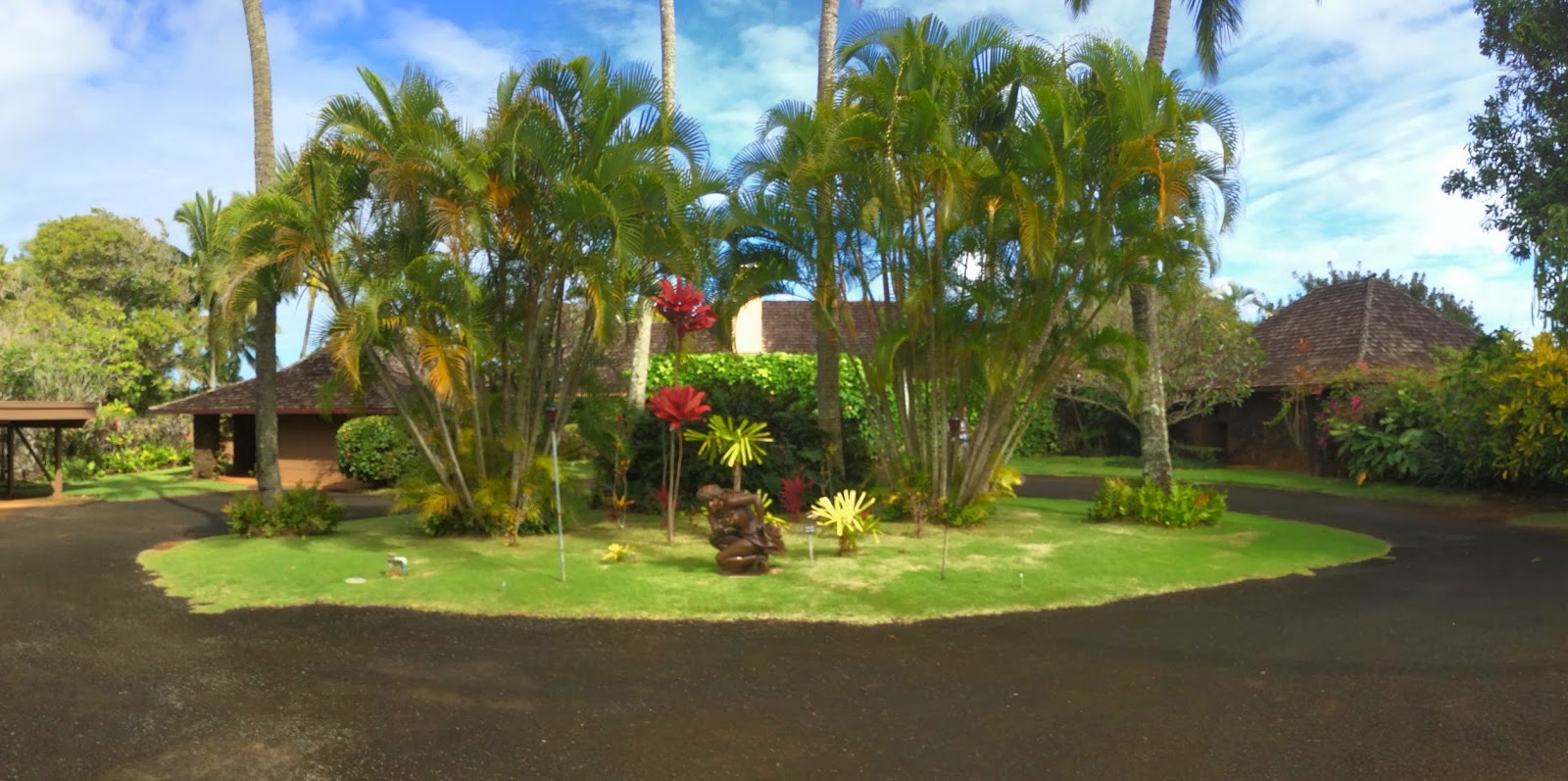


This was pretty funny.  Here is the front entrance to the house.  They must have had some gripe against tall people because this vine (Mucuna bennettii aka Red Jade Vine) is trimmed to about four feet off the ground.  Either that or Willy Wonka lived here.


There were only a few blooms when we were there but apparently this vine can become almost completely covered in flowers when it's at it's peak.


Mucuna bennettii
We weren't allowed to go swimming.


If I were to live in Hawaii and build a swimming pool, it would look something like this.


That does if for Part 2.  I'll be doing a few more posts on Hawaii - there's just so much to cover!!


Wednesday, March 19, 2014

Doing it Island Style, Part 1: Princeville Botanical Gardens

The wonders of modern technology.  In five short hours you can leave the cold, wet, dark, miserable Seattle winter weather and go somewhere completely superior.  That's exactly what I did last month - the superior place being Hawaii.  We stayed on the island of Kauai, also known as the garden island since it is geologically the oldest and therefore the most ecologically diverse.  Apparently they don't take security too seriously either judging from the lack of windows in the airport corridor:


During our week in paradise, we visited two botanical gardens.  The first one was just outside of Hanalei (no relation to Puff the Magic Dragon by the way) named Princeville Botanical Gardens.  It was planted fairly recently in 2001 but easily looks like it has been there twice as long.

Like any respectable botanical garden, a river runs through it.
Throughout the three-hour guided tour, samples were placed in bags next to selected fruit trees for us to try.  Below, our tour guide is opening one of the bags.  Inside were things like apple bananas, orange slices, cocoa nibs, longan (dragon eye fruit), and other odd tropical fruit.


Hawaiian horticulture is slightly confusing.  There are three names for every plant: the common name, the botanical name, and the Hawaiian name.  The screw pine (Pandanus tectorius), for example, in the picture above is known by the Hawaiians as a Hala tree.  Plants that were originally introduced by the Polynesians hundreds of years ago are called canoe plants (since they came over in canoes) but these are often considered Hawaiian natives which they really are not (Cordyline fruticosa or Ti plant is an example).

Euphorbia punicea (Flame of Jamaica)
It would sure be nice to live in a place that never drops below 50 degrees.  No hardiness zones to worry about.  The bottlebrushes grow into trees and bloom in the middle of winter.

Weeping bottlebrush (Callistemon viminalis)
The fluorescent orange rhododendrons were pretty amazing too.


Speaking of orange, look at this orange tree!  I should have asked what they used to fertilize it.

 
Hoffmannia arborescens was new to me.  I thought it might be a type of fig but it's actually in the coffee/gardenia family.

Hoffmannia arborescens (relative of the Taffeta plant)
Fossilized pathways.


Aerial palm tree roots.


This area is going to become part the garden in the future.  They are currently in the process of clearing out all the invasive vegetation.


This fishtail palm (Caryota gigas) blew my mind.  It's hard to grasp the size of it from the picture.  The dead frond that is falling off was about 20 feet wide by 40 feet long!  Oh, and it's only eight years old.


Solandra maxima or Cup of Gold looks like a lily but is actually in the nightshade (tomato) family.  It has a similar smell to Angel's trumpet (Brugmansia).


A small Baobab tree.  It will put on a bit more bulk when it reaches maturity in 2,000 years.


Heliconias were everywhere.  


Another one that looked like a herd of giant caterpillars.


This is what a poinsettia looks like when it's not in the process of dying on the mantle in the living room during Christmas.


Halfway through the tour, they had a chocolate tasting.  They make their own chocolate from the trees growing in the garden.


Here is one of their chocolate trees.

Theobroma cacao aka chocolate tree
A vanilla orchid unfortunately not in bloom. 

Vanilla planifolia
  A nutmeg tree unfortunately not in nut.

Monodora myristica aka African nutmeg
Pride of Burma - the floral equivelant of a chandelier.

Pride of Burma (Amherstia nobilis)
Bromeliads growing happily in a rockery.


I could go on but I have to end at some point so that does it for Part 1.  Stay tuned for Part 2 where we will travel to the gardens of Na 'Āina Kai.

A desert rose (Adenium obesum) and giant aloe just out of bloom.

Friday, February 21, 2014

New Plants!

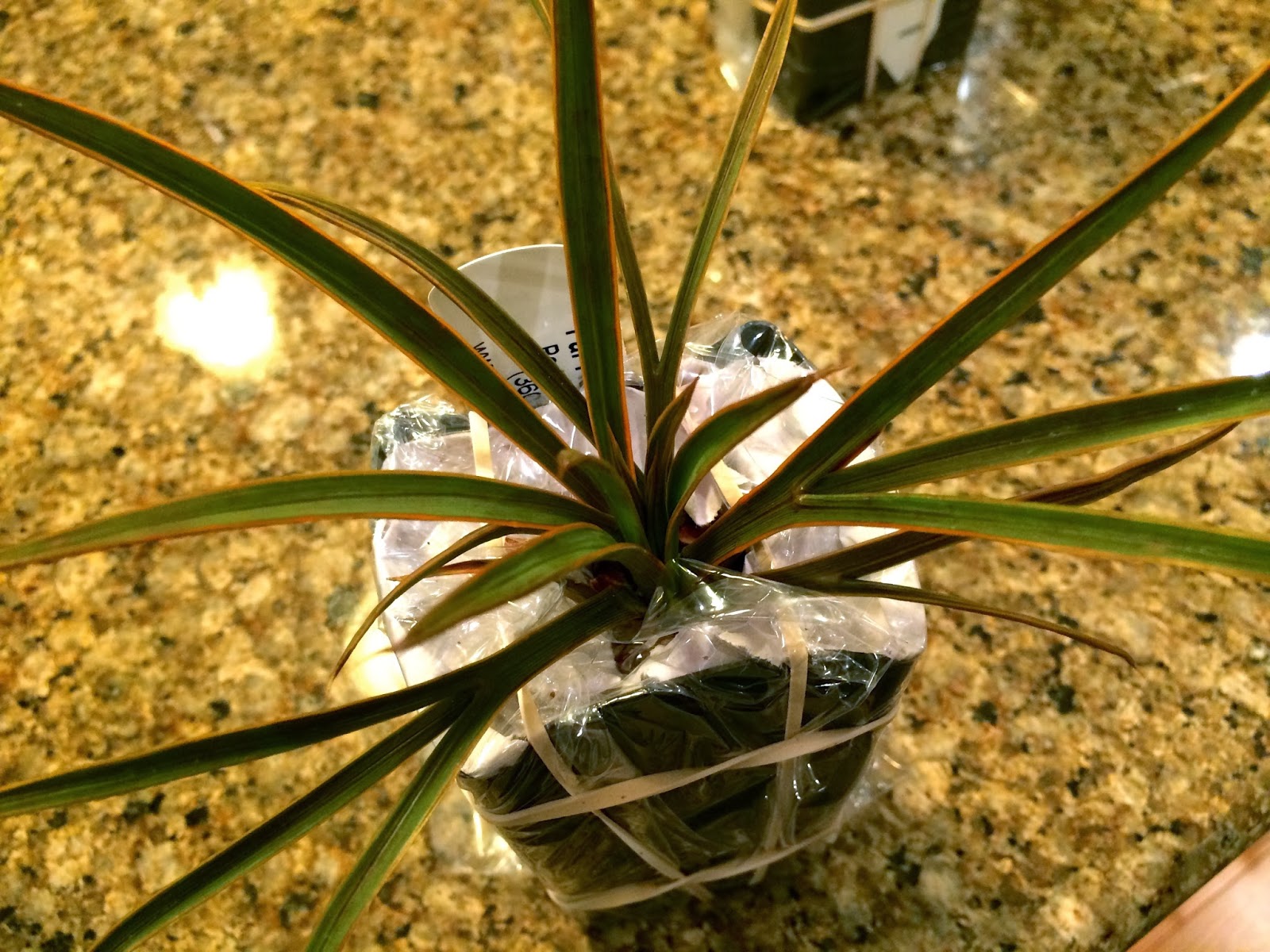
Far Reaches Farm is becoming increasingly difficult to keep up with.  After getting their e-mailed newsletter a few weeks ago stating they had added some new plants to their online store, I spent the next hour going through their new inventory whittling down my wish list to get to an acceptable number of plants to buy.  I spent more on plants than on food in 2013 so this year I'm shooting to go revenue-neutral meaning I'm going to try to sell as many plants as I buy.  Of course the less plants I buy the easier this will be but I'm looking at it the other way around: the more plants I sell, the more I get to buy :)

After a four-day wait, the box of plants finally arrived.  Here is what was inside:

Michelia sp. CDHM 14653
Raukaua laetevirens (syn. Pseudopanax)
Hydrangea angustipetala DJHV 7004
Cardiandra amamioshimensis
Iris henryi - Clone #2
Aciphylla aurea
Contined below....

New Plants! (continued)

Iris foetidissima 'Nant Gwilw'
Veronica thessalica
Schisandra sp. CDHM14525
Melianthus major 'Purple Haze'
Kadsura heteroclita FMWJ 13385
Tropaeolum tuberosum 'Ken Aslet' & Sinopodophyllum hexandrum var. chinense ex MD97150

Thursday, February 13, 2014

The Big Garden Show


The Northwest Flower & Garden Show this past weekend was once again a visual feast abounding in imaginative garden design and cutting edge horticultural knowledge.  The first time I attended was in 2005 making this my 10th show.  It has definitely improved over time.  Remember the days having to sneak into seminars because they ran out of tickets?  My favorite part of the show remains the seminars and so this post is really seminar-focused. 

Spiky plants meet Ikea
First off, Kelly & Sue from Far Reaches Farm talked about Plant Crack for Plant Junkies.  They did not have handouts so I tried to make as comprehensive a list as possible.  Most of these plants are unavailable in the trade and a few don't even have pictures on the Internet yet.

Maianthemum (Smilacina) aff. flexuosum - Pink False Solomon Seal
Podophyllum aurantiocaule - You can only but this plant if you live in the UK
Mertensia maritima - Blue bells
Hebe recurva - One of the hardiest hebes - to Zone 7 (0 degrees F/-18C)
Meconopsis baileyi 'Hensol Violet'
Rhododendron kamtschaticum - Deciduous, dwarf alpine/rock garden rhody
Leposaurus - Fern (not sure which species they were discussing)
Mahonia eurybracteata (syn. M. confusa)
Dactylorhiza fuchsii 'Bressingham Bonus'
Gold leaved blue poppy - Beautiful contrast of colors.  Unfortunately not for sale yet.
Lobelia excelsa x lobelia tupa - A cross between the shrubby L. excelsa and perennial L. tupa
Roscoea 'Red Gurkha' - FRF is currently working on hybridizing different Roscoea species
Illicium sp. KCSH# - Star Anise
Disporum cantoniense
Epimedium pseudowushanense
Daphniphyllum sp. (longiracemosa?)
Dendropanax proteusen - Evergreen tree in the aralia family
Evergreen Corylopsis - I think this is an unknown species
Actinoitum purple flowers
Ligularia nilumbifolia - Big leaves
Styrax japonicus - White leaves?
Tripterospermum - Climbing gentian relative
Daphne wolongensis
Disporopsis ginfosinensis
Neolitsea sp. - Broadleaf evergreen (unknown species)
Nothotsuga longibracteata - This is the tree Far Reaches Farm has on their logo
Gaultheria
Native salal with pink flowers
Variegated Mahonia nervosa
Stenanthium angustifolium - purple bell-shaped flowers
Campanula - Native to the Olympic mountains
Paris quadrifolia
Berberis jamesiana
Tropaeolum vine - Perennial, summer-blooming nasturtium
Desfontainia spinosa & Desfontainia fulgens
Lapageria - National flower of Chile
Gentiana "Asiatic Hybrids" - Fall blooming gentian
Gentiana ternifolia
Colchicum agrippinum
Pittosporum 'Tom Thumb' - Red-burgundy evergreen foliage


Hey! I have these!
Dan Hinkley talked about Good Weed (aka Sedges, rushes, grasses and restios and not the other kind that just became legalized).  He admitted he held out using ornamental grass in garden landscapes until well after it became popular but having personally seen his garden at Windcliff, it is clear that he has fully embraced the concept.

Sedges
Acorus gramineus 'Ogon' - Looks great year-round and very foolproof
Muhlenbergia dumosa - Not hardy
Carex elata 'Bowles Golden' - Boggy grass
Carex pendula - I was glad to hear Dan recommend this plant because I've wondered about its potential invasiveness.  It makes a nice 4' tall clump and looks great 365 days a year.
Carex flagellifera - One of several of the bronze-colored sedges.  It only has a lifespan of 3-4 years but reseeds readily.
Carex buchananii - Taller bronze sedge
Carex testacea - Soft and orange

Rushes
Luzula nivea - Snowy wood rush
Luzula sylvatica - Wood rush

Grasses
Stipa gigantea - Evergreen early blooming sparkles in the sun
Stipa tenuissima - Mexican feather grass
Panicum virgatum 'Northwind' - Autumn switchgrass (2014 perennial plant of the year)
Panicum virgatum 'Shenandoah' - Red foliage 2-3 ft tall
Panicum Virgatum 'Blood Brothers' - Better color than 'Shenandoah'
Cortaderia selloana 'Pumila' - Dwarf pampas grass
Molinia caerulea 'Skyracer'
Molinia caerulea 'Strahlenquelle'
Molinia caerulea 'Variegata'
Hakonechloa macra 'Aureola' - Plantings of this withstood several years of complete neglect at Heronswood and still look great after 30 years
Chionochloa rubra - Annie's Annuals used to sell it before Dan Hinkley mentioned it

Restios
Elegia capensis - Not a horsetail!
Apodasmia simili
Rhodocoma capensis - Large plumes flowing in the wind give the effect of it being underwater

That does it for my coverage of the show.  Next year's show will move to February 11-15th, 2015.  If you live in the Pacific Northwest be sure to check it out!