Showing posts sorted by relevance for query Miller garden. Sort by date Show all posts

Sunday, May 12, 2013

It's Miller Time

I've visited Seattle's Elisabeth C. Miller in October, June, and now May.  I have to say, in terms of the garden looking its best, May wins.  Spring ephemerals and many rhododendrons are in bloom, freshly unfurled fronds festoon a flood of fine ferns, and having a nice and sunny mid-spring day, the thrust of the growing season kicking into high gear was spine-tingling.

I should mention before getting started I did already post a 3-part series on the Miller Garden last year, but considering the garden's many rare & exotic specimens, there is always plenty of new ground to cover...

An overall view of the garden.
Our group of about 10 was guided by the curator of the Miller Garden, Richie Steffen.  I think he literally knows every plant in the garden. 

Heading into the dense, wooded area of the garden.
Woodwardia fimbriata (Giant chain fern)
I was amazed to discover we have a native fern that is evergreen and has gigantic 6'+ long fronds.  It is called Woodwardia fimbriata or Giant chain fern.  Its range is from northern California to southern British Columbia, making it hardy to at least 0 degrees F/-18C.


When woodpeckers started drilling into an old cedar tree next to Mrs. Miller's house, the garden's oversight board figured the tree was rotting from the inside out and decided to take it down.  They had the trunk cut up in pieces and placed them around the garden.  Just like in an old growth forest, the old rotting wood is making a new home for new generations of plants.

Paris polyphylla
Paris polyphylla, a lily relative, is strikingly thin and elegant.  It's cousin, Paris japonica, has the largest genome of any living organism (Its DNA sequence 50 longer than a human).  Just thought I'd throw that in.

Plants of different shapes, textures, and shades of green create living tapestries.
Blechnum novae-zelandiae
This is an evergreen fern called Blechnum novae-zelandiae.  As its name implies, it's a New Zealand native.  It makes a nice tall groundcover.

Rhododendron 'Walter Maynard'
Borderline-hardy rhododendrons seem to work well in pots, where they can be carted under cover should a wintery arctic blast strike.  This cultivar is called Rhododendron 'Walter Maynard'.  Its giant white blossoms are very fragrant.  I believe the garden has about 20 of these placed throughout the premises, each growing in a pot so it can be carted to safety should winter ever turn ugly. 


I was straggling way behind when I took the above photo, otherwise I would have asked what the names of two plants were.  Some kind of epimedium and eucomis?  That's about as good as you're going to get from me....

Hydrangea aspera 'Plum Passion'
Judging from the name, this hydrangea is a hybrid, but it was apparently collected by Dan Hinkley, who is a plant explorer and not really a hybridizer.

Bonsai wisteria?
Rhododendron makinoi?
Podophyllum 'Spotty Dotty', among others
Of course the Miller garden is the type of place that would have mounds and mounds of Podophyllum delavayi.  I've had many opportunities to buy this plant, but paying $50 for a root cutting is just not going to happen.

Podophyllum 'Kaleidoscope'
Arisaema griffithii
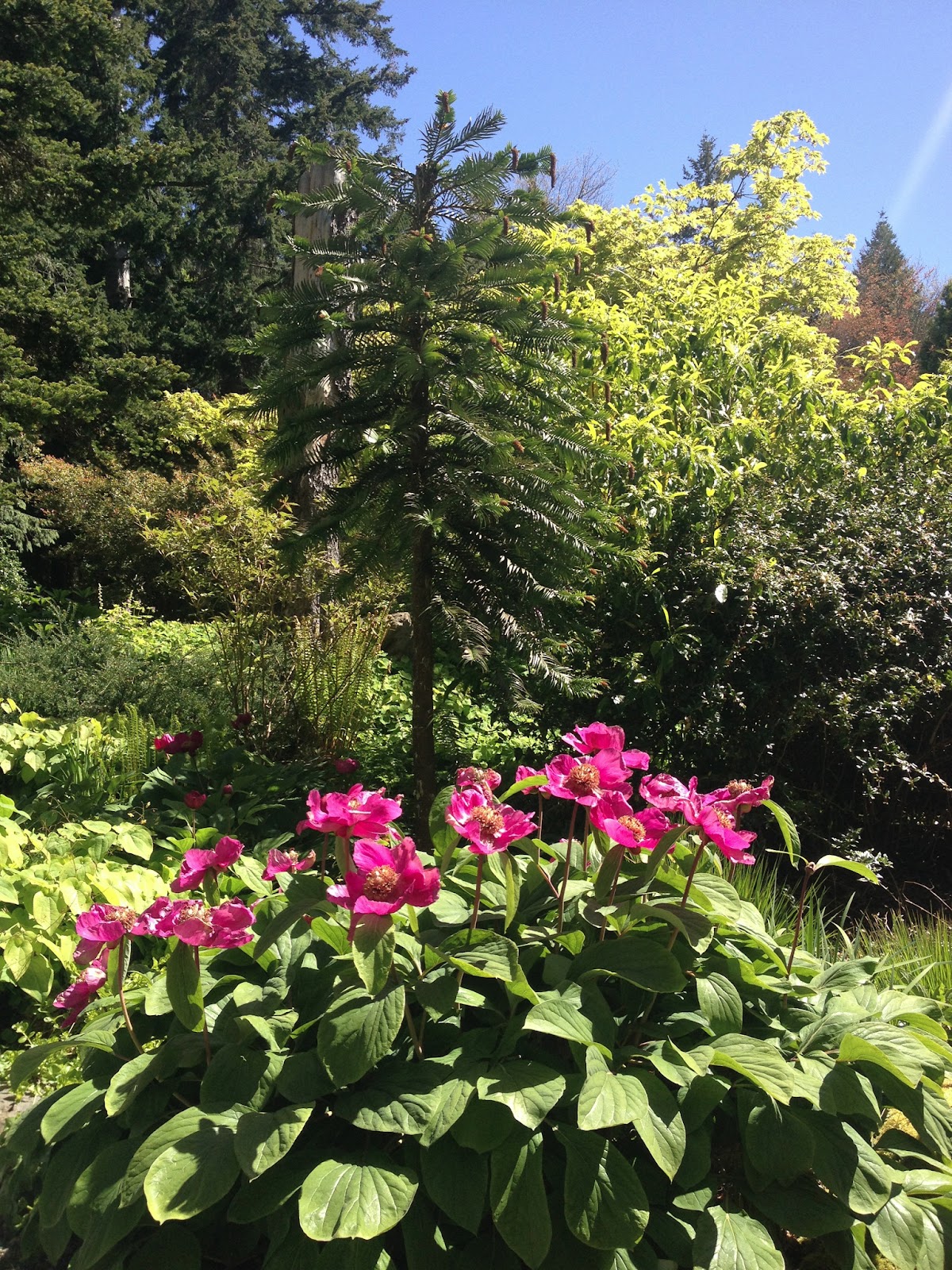
Wollemia nobilis
Behind these peonies (at least I think they're peonies) is one of their larger Wollemi pines.  According to Steffen, the Miller Garden has the largest collection of Wollemi pines this far north.

Dicksonia antarctica (Tasmanian tree fern) in the background.  I'm not sure what the plant with white flowers is.  Could be a hardy orchid perhaps.
They had a schefflera, not sure of the species
Podophyllum pleianthum
Rheum palmatum var. tanguticum
Their greenhouse is way too empty...
Cyperus sp. (Possibly Cyperus glaber)
And now for the best part.  I saw how this papyrus was growing and suspected that it had overwintered in the ground.  When I asked Richie about it, he said it was a hardy papyrus and had been growing there for several years.  Right at that point, I heard the sound of trumpets echoing in the heavens as I entered into a new stage of enlightenment.  Hardy papyrus?  How did I not know about this before?!?!?  They are in the genus Cyperus but the species name is unknown.  To my utter amazement and forever indebtedness, when we finished our tour, I was handed a 1 gallon specimen to take home.  Richie told me how to propagate it from leaf nodules...so at some point I just might have some to share!

Now some bad news: The Miller Garden is already sold out for 2013 but check their website in September or sign up for a Northwest Horticultural Society class at the Miller Garden to try for a spot in 2014.  With a bit of initiative, it's pretty easy to be one of the 500 guests allowed into the garden each year. 

Sunday, July 1, 2012

Around the Miller Garden, Part 1

View looking west toward Puget Sound
The Elisabeth C. Miller Botanical Garden in North Seattle opened to the public in the mid-90's after the world-renowned horticulturist had passed away and willed her estate to become a botanical garden.  The gated community surrounding it was not too happy about the potential increase in vehicle traffic, so the garden is forced to limit the number of visitors per year to 500.  So it is a garden that is impossible to get into, filled with many plants that are impossible to find.

Here is an example of a plant you can't get, a ground-hugging fern in the Blechnum genus: 

Blechnum (species unknown)
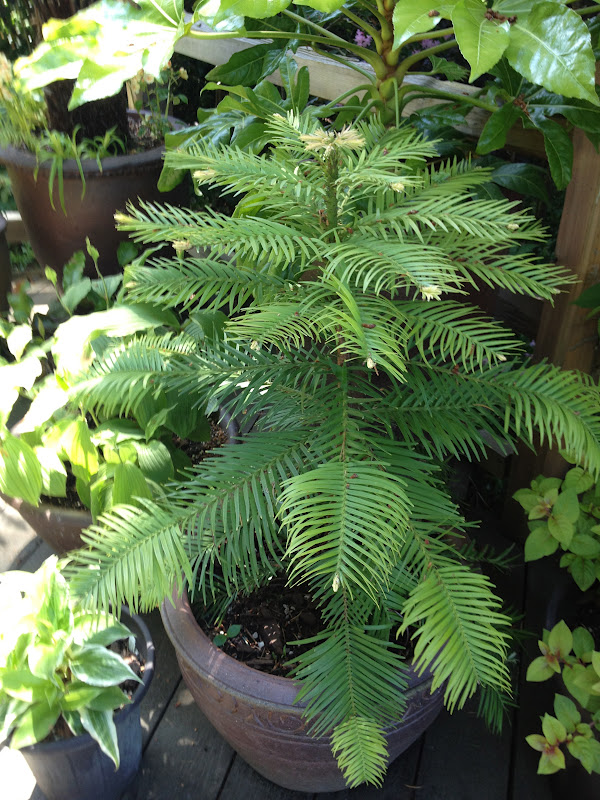
Another hard-to-find plant, the Wollemi pine (Wollemia nobilis), was known only through fossil records until 1994 when a small population of about 100 trees were found growing in the Blue Mountains in Australia.  This incredible discovery led to a movement around Australia to cultivate the pine, even using it as a living Christmas tree, in order to help maintain its survival as a species.  It is still extremely difficult to find in the US (otherwise I would be growing one).

A small Wollemia nobilis
A larger Wollemia nobilis
Eventually, these plants will trickle down to the rest of us.  As an example, Japanese forest grass was once so rare that Mrs. Miller's garden was one of the only places in the Western hemisphere you could find it.  Now it is very common.

Hakonechloa macra 'Aureola' (Japanese Forest Grass)
Plants from Japan are well-represented in the Miller Garden, with over 50 varieties of Japanese Maples alone.  Here are some outstanding specimens:

Acer palmatum 'Scolopendrifolium'
Acer palmatum 'Arakawa' (Rough bark maple)
Acer palmatum 'Shishigashira' (Lion's Head Maple)
Acer palmatum 'Villa Taranto'
Continue on to Part 2.

Tuesday, July 3, 2012

Around the Miller Garden, Part 3


The majority of the Miller Garden is shrouded in shade, but there is a small "sun area" filled with bromeliads, aloes, agaves, and other desert dwellers.

I should have asked what this one is.  It looks like it might be evergreen.  Maybe a contorted purple hopseed bush?


I don't think the bark on this manzanita would be any smoother if I were to sand and polish it myself.

Arctostaphylos manzanita
They could use a few more pots, right?


The very dead manzanita in the background of this photo sadly got bit by the despicable frost of November 2010.


While trying to figure out what kind of dyckia this is, I discovered a plant that is going immediately to the top of my plant wish list.  It's called Dyckia 'White Fang' and if it looks as cool in real life as it does in pictures, I'm in dyckia heaven.  You'll have to Google it.  This is not it: 

A white dyckia
Well, I know it was fast, but your virtual tour of the Miller Garden has come to an end.  If you have never visited in person, the best way to go is to sign up for a class at the Miller Garden through the Northwest Horticultural Society website.  Good luck!

Nolina nelsonii

Friday, February 10, 2012

The Northwest Flower & Garden Show, Part 1


The Northwest Flower & Garden Show this year is centered around music in the garden. In many ways, music existed in gardens long before Bach ever thought about tempering his clavier. There have always been the melodic elements of native bird calls, rustling bamboo in the wind, and endlessly bubbling creeks. Additionally, there are parallels that can be drawn between a well-composed symphony and a well-composed garden. Elements do not just occur randomly, but they're all connected to embody a work of art that is unique and inspiring. In a garden, these elements are orchestrated by man, but they are executed by nature. The gardener is the composer while nature is the symphony.


Now, for those who have never been, a little NWFG show 101. There are four reasons to go to the NWFG show. The main reason is the seminars. That is where you really learn a wealth of information on a wide variety of topics relating to horticulture. The second reason is connecting with people and learning from their expertise. I talked with a potato farmer from Ellensburg for a good 20 minutes, and learned pretty much everything I ever wanted to know about growing potatoes. The third reason is the plant market. Although all the plants are pretty much 1 gallon size or smaller, they have a better selection here than anywhere else in the universe. I usually end up doubling my plant budget by the time I'm done, sometimes more than once. The forth reason to go is to look at the display gardens. Granted, the display gardens are really just a fantasy. Nothing in the real world would ever look like them. But the whole point is really to inspire and get you in the gardening spirit. I think they do a pretty good job with that. Having said that, can someone turn the lights up on them? I know saving energy is cool, but it would be nice to be able to read the plant tags and take non-blurry pictures. Just a thought.

So here is a rundown of the seminars I've already gone to:

"Plant of the Week" by Ciscoe Morris. Ciscoe talked about his favorite plants, organizing them by the months they're at peak-performance. As usual, he only got to July before running over and being kicked off the stage.

"Shade Gardens Rule" by Kelly Dodson & Sue Milliken. These are the owners of the new best nursery in the world: Far Reaches Farm. Some of their favorite shade plants include Beesia calthifolia, Podophyllum versipelle, and a pink-flowered Cardiocrinum giganteum.

"Container Garden Compositions" by Barbara Wise. Barbara is a garden designer in Nashville, and grows a lot of subtropical plants I love: Alocasias, Mandevilla vines, and Bougainvilleas to name a few.

"Survivors: Indianola" by Dan Hinkley. When I was growing up, even while I was in college, I had assumed that all the plants on earth had been discovered. That is far from the case. To this day there are perhaps thousands of garden-worthy plants that are not available in the trade. Dan Hinkley has done a lot to bridge this gap, which is why I am a huge fan of his. Some of the plants he discussed that weathered the previous three brutal winters include: Rhodocoma capensis, Embothrium coccineum, Musa sikkimensis, and the genuses of Eucomis and Dierama.

"The Peak of Perfection" by Colin McCrate. The first 15 minutes of this seminar consisted of a discussion on basic plant biology. I almost fell asleep, but then he discussed how he cultivates individual vegetables which was interesting and informative.

"What the Cluck?! Part 1" by Jessi Bloom. She discussed her personal adventures in raising chickens and made a very good case for integrating chickens into the garden.

"Reliable Plants for the Shade Garden" by Richie Steffen. Richie is the curator for the Miller Garden, an incredible garden in North Seattle filled with hundreds of rare plants. One plant he grows that stood out was the evergreen maidenhair fern, Adiantum venustum.

In spite of a slight scale-back this year in terms of size and scope, creativity abounded everywhere at the show. So much so that my head was about twice the normal size by the end of the day. One creative display garden had drops of water hitting differently tuned drums at different intervals (see the picture below). I got to thinking, there must be a way to be able to control the timing automatically, in which case you could have the drops of water play a song with a set of diatonically tuned drums.


Finally, here is a picture of some of the plants that managed to hitch a ride back with me:


Pictures from more or less left to right: 'All Red' potatoes, two free pansies, Arum italicum 'White Winter', Dierama 'Dark purple-violet', Arum 'Chameleon', Acanthus mollis 'Tasmanian Angel', Syneilesis aconitifolia, Oxalis adenophylla, Taxus baccata 'Amersfoort', Polygala chamaebuxus 'Kamniski', Euphorbia tirucalli 'Rosea', Butia capitata (Pindo Palm), Helleborus foetidus 'Wester Flisk' and Selaginelia braunii.

On to Part 2...

Monday, July 2, 2012

Around the Miller Garden, Part 2


Mrs. Miller planted so many trees on her 7-acre estate overlooking Puget Sound that what could potentially be a panoramic view of the water framed by a few trees is more like a view of a lot of trees framed by a couple narrow views of the water.

One of the culprits is this live oak, Quercus chrysolepis, which happens to be a state champion.

Quercus chrysolepis (Canyon live oak)
It is practically begging to have a tree house build in it.

Quercus chrysolepis (Canyon live oak)
A giant Schefflera delavayi looking happy. Yes, it is evergreen and reliably hardy in the greater Seattle area (to around 5F/-15C).  It seemed a little out of place here because the tropical look is decidedly not a theme in the Miller Garden, but I'm glad to see them growing it anyway.  I also noticed a couple Schefflera taiwanianas growing in pots.

Schefflera delavayi
There is one big drawback to the Miller Garden: name tags are few and far between.  None of the groundcovers, perennials, or small shrubs had name tags and very few of the trees did.  So while I know this plant below is in the rhubarb family, I don't know much more about it.

Mystery Rhubarb
I think this is a Mahonia fortunei.

Mahonia fortunei?
Along with Rhododendrons & Japanese maples, their collection of ferns is very extensive.  This is a fern called Pyrrosia sheareri.  Most of the old fronds from last year still look great.

Pyrrosia sheareri
Adiantum pedatum (Northern Maidenhair fern)
I have no idea what this is:

Mystery fern
They also have one of the most incredible nurseries filled with thousands of rare plants, but nothing is for sale.  I find that a bit odd because they could raise a lot of money from people like me trying to spend their life savings on rare plants.

Tables filled with plants you've never seen before
Inside one of the greenhouses
I don't know what this is, but I want it!!
Extensive hepatica collection
Even though you can't buy a single plant, they are nice enough to give away a free one at the end of the tour.  I left with an Ercilla volubilis, which is an evergreen vine that Far Reaches Farm happens to be selling on their website.

Ercilla volubilis
Continue on to Part 3.